

1 B/s = 0.000007629394531 Mibps
Bytes Per Second to Mebibits Per Second Converter: B/s to Mibps Conversion Calculator
To convert bytes per second to mebibits per second (B/s to Mibps), enter your byte per second value in the From box and click the Convert button. Your mebibit per second result also appears in the To box as you type, mixing SI decimal and binary (IEC) prefixes and converting between bits and bytes. This free B/s to Mibps converter and conversion calculator also works vice versa: type in the To box to convert Mibps back to B/s, use Swap units to flip the pair, or Reset to start over.
Byte Per Second (B/s)
One byte (8 bits) transferred per second. The fundamental byte-based transfer rate.
View the byte per second data unit pageMebibit Per Second (Mibps)
A mebibit per second is 1,024 kibibits per second. Binary equivalent of Mbps.
View the mebibit per second data unit pageHow to Convert Bytes Per Second to Mebibits Per Second
To convert bytes per second to mebibits per second, multiply by 0.000007629394531. This conversion translates actual file transfer speeds (bytes) to network bandwidth (bits) by accounting for the 8:1 bit-to-byte ratio.
B/s represents your actual download or transfer speed—what you see in your browser or file manager when copying files.
Mibps is the equivalent network bandwidth. Use this when comparing against ISP plans, sizing network links, or calculating replication bandwidth requirements.
1 B/s = 0.000007629394531 Mibps — or equivalently, 1 Mibps = 131,072B/s.
B/s to Mibps transfer rate: 1 byte per second equals 0.000007629394531mebibits per second — the standard bandwidth conversion rate used by this data transfer calculator.
Quick Facts: B/s to Mibps Speed Conversion
- Conversion factor: 1 B/s = 0.000007629394531 Mibps
- Reverse factor: 1 Mibps = 131,072 B/s
- Source unit type: byte-based throughput
- Target unit type: binary bit-based
- Useful for: estimating download times, comparing advertised speeds, and network capacity planning
- Category: data transfer rate converter, network speed calculator, bandwidth converter
Steps to Convert Byte Per Second to Mebibit Per Second
- Enter your byte per second value (B/s) into the byte per second to mebibit per second converter above.
- The equivalent mebibits per second (Mibps) transfer speed appears instantly in the To box using the B/s to Mibps conversion factor; click the Convert button to recalculate and highlight the result.
- To convert mebibits per second back into bytes per second, type in the To box instead, or use the swap control to flip the pair.
B/s to Mibps Conversion Formula
Here's the exact B/s to Mibps formula in copy-paste-ready form — multiply by 0.000007629394531 to go from bytes per second to mebibits per second, or by 131,072 to reverse it — followed by a quick-reference chart of the same rate conversion.
// Convert B/s to Mibps
Mibps = B/s × 0.000007629394531

// Reverse: Convert Mibps to B/s
B/s = Mibps × 131,072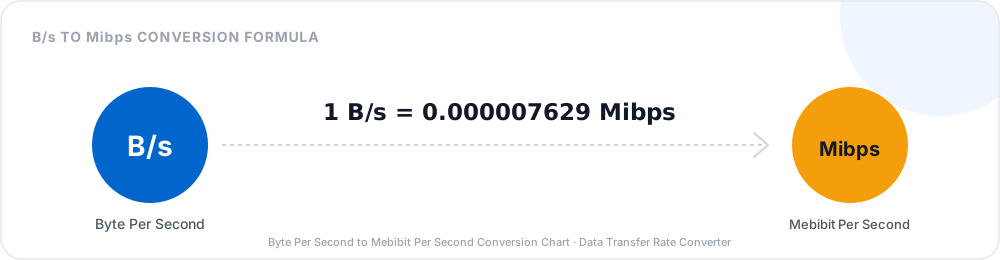
Byte Per Second to Mebibit Per Second Conversion Examples
10 B/s = 0.000076293945313 Mibps
50 B/s = 0.000381469727 Mibps
100 B/s = 0.000762939453 Mibps
500 B/s = 0.003814697266 Mibps
1,000 B/s = 0.007629394531 Mibps
Most data transfer rate units step by powers of ten: moving up the scale (bps → Kbps → Mbps → Gbps and beyond) means multiply by 1000, moving down means divide by 1000 — usually just a matter of shifting the decimal point. What's actually being counted underneath is bits: the binary digits, 0s and 1s, that make up every network signal.
What Is Byte Per Second (B/s)? Definition and Uses
One byte (8 bits) transferred per second. The fundamental byte-based transfer rate.
The byte per second is a byte-based throughput unit measuring data transfer speed, network bandwidth, or throughput capacity. Like the units used to measure file size, it's one of several data measurement units that scale using either decimal multiples of 1,000 (SI) or binary steps of 1,024 (IEC).
Common uses: File transfer displays, storage benchmarks, precise measurements
1 B/s = 8 bits per second .
The byte per second can be abbreviated as B/s; for example, 1 byte per second can be written as 1 B/s.
Byte Per Second Transfer Rate Unit at a Glance
| Unit type | byte-based throughput |
|---|---|
| Symbol | B/s |
| Common uses | File transfer displays, storage benchmarks, precise measurements |
What Is Mebibit Per Second (Mibps)? Definition and Uses
A mebibit per second is 1,024 kibibits per second. Binary equivalent of Mbps.
The mebibit per second is a binary bit-based unit measuring data transfer speed, network bandwidth, or throughput capacity. Like the units used to measure file size, it's one of several data measurement units that scale using either decimal multiples of 1,000 (SI) or binary steps of 1,024 (IEC).
Common uses: Precise network specifications, binary bandwidth measurements
1 Mibps = 1 × 10⁶ bits per second .
The mebibit per second can be abbreviated as Mibps; for example, 1 mebibit per second can be written as 1 Mibps.
Don't confuse Mibps with MiB/s (Mebibyte Per Second) — capitalization matters here. Mibps measures bits, MiB/s measures bytes, and since 1 byte = 8 bits, 1 Mibps works out to just 0.125 MiB/s using the same numeral.
Mebibit Per Second Transfer Rate Unit at a Glance
| Unit type | binary bit-based |
|---|---|
| Symbol | Mibps |
| Common uses | Precise network specifications, binary bandwidth measurements |
Byte Per Second to Mebibit Per Second Conversion Table
The table below shows 100 byte per second measurements converted to mebibits per second — scroll within the table to see the full range. Bookmark this reference table for quick lookups whenever you need to convert a value without shifting the decimal point by hand.
| Bytes Per Second | Mebibits Per Second |
|---|---|
| 1 B/s | 0.000007629395 Mibps |
| 13 B/s | 0.000099182129 Mibps |
| 26 B/s | 0.0001983643 Mibps |
| 39 B/s | 0.0002975464 Mibps |
| 52 B/s | 0.0003967285 Mibps |
| 65 B/s | 0.0004959106 Mibps |
| 78 B/s | 0.0005950928 Mibps |
| 91 B/s | 0.0006942749 Mibps |
| 104 B/s | 0.000793457 Mibps |
| 117 B/s | 0.0008926392 Mibps |
| 130 B/s | 0.0009918213 Mibps |
| 143 B/s | 0.0010910034 Mibps |
| 156 B/s | 0.0011901855 Mibps |
| 169 B/s | 0.0012893677 Mibps |
| 182 B/s | 0.0013885498 Mibps |
| 195 B/s | 0.0014877319 Mibps |
| 208 B/s | 0.0015869141 Mibps |
| 221 B/s | 0.0016860962 Mibps |
| 234 B/s | 0.0017852783 Mibps |
| 247 B/s | 0.0018844604 Mibps |
| 260 B/s | 0.0019836426 Mibps |
| 273 B/s | 0.0020828247 Mibps |
| 286 B/s | 0.0021820068 Mibps |
| 299 B/s | 0.002281189 Mibps |
| 312 B/s | 0.0023803711 Mibps |
| 325 B/s | 0.0024795532 Mibps |
| 338 B/s | 0.0025787354 Mibps |
| 351 B/s | 0.0026779175 Mibps |
| 364 B/s | 0.0027770996 Mibps |
| 377 B/s | 0.0028762817 Mibps |
| 390 B/s | 0.0029754639 Mibps |
| 403 B/s | 0.003074646 Mibps |
| 416 B/s | 0.0031738281 Mibps |
| 429 B/s | 0.0032730103 Mibps |
| 442 B/s | 0.0033721924 Mibps |
| 455 B/s | 0.0034713745 Mibps |
| 468 B/s | 0.0035705566 Mibps |
| 481 B/s | 0.0036697388 Mibps |
| 494 B/s | 0.0037689209 Mibps |
| 507 B/s | 0.003868103 Mibps |
| 520 B/s | 0.0039672852 Mibps |
| 533 B/s | 0.0040664673 Mibps |
| 546 B/s | 0.0041656494 Mibps |
| 559 B/s | 0.0042648315 Mibps |
| 572 B/s | 0.0043640137 Mibps |
| 585 B/s | 0.0044631958 Mibps |
| 598 B/s | 0.0045623779 Mibps |
| 611 B/s | 0.0046615601 Mibps |
| 624 B/s | 0.0047607422 Mibps |
| 637 B/s | 0.0048599243 Mibps |
| 650 B/s | 0.0049591064 Mibps |
| 663 B/s | 0.0050582886 Mibps |
| 676 B/s | 0.0051574707 Mibps |
| 689 B/s | 0.0052566528 Mibps |
| 702 B/s | 0.005355835 Mibps |
| 715 B/s | 0.0054550171 Mibps |
| 728 B/s | 0.0055541992 Mibps |
| 741 B/s | 0.0056533813 Mibps |
| 754 B/s | 0.0057525635 Mibps |
| 767 B/s | 0.0058517456 Mibps |
| 780 B/s | 0.0059509277 Mibps |
| 793 B/s | 0.0060501099 Mibps |
| 806 B/s | 0.006149292 Mibps |
| 819 B/s | 0.0062484741 Mibps |
| 832 B/s | 0.0063476563 Mibps |
| 845 B/s | 0.0064468384 Mibps |
| 858 B/s | 0.0065460205 Mibps |
| 871 B/s | 0.0066452026 Mibps |
| 884 B/s | 0.0067443848 Mibps |
| 897 B/s | 0.0068435669 Mibps |
| 910 B/s | 0.006942749 Mibps |
| 923 B/s | 0.0070419312 Mibps |
| 936 B/s | 0.0071411133 Mibps |
| 949 B/s | 0.0072402954 Mibps |
| 962 B/s | 0.0073394775 Mibps |
| 975 B/s | 0.0074386597 Mibps |
| 988 B/s | 0.0075378418 Mibps |
| 1,001 B/s | 0.0076370239 Mibps |
| 1,014 B/s | 0.0077362061 Mibps |
| 1,027 B/s | 0.0078353882 Mibps |
| 1,040 B/s | 0.0079345703 Mibps |
| 1,053 B/s | 0.0080337524 Mibps |
| 1,066 B/s | 0.0081329346 Mibps |
| 1,079 B/s | 0.0082321167 Mibps |
| 1,092 B/s | 0.0083312988 Mibps |
| 1,105 B/s | 0.008430481 Mibps |
| 1,118 B/s | 0.0085296631 Mibps |
| 1,131 B/s | 0.0086288452 Mibps |
| 1,144 B/s | 0.0087280273 Mibps |
| 1,157 B/s | 0.0088272095 Mibps |
| 1,170 B/s | 0.0089263916 Mibps |
| 1,183 B/s | 0.0090255737 Mibps |
| 1,196 B/s | 0.0091247559 Mibps |
| 1,209 B/s | 0.009223938 Mibps |
| 1,222 B/s | 0.0093231201 Mibps |
| 1,235 B/s | 0.0094223022 Mibps |
| 1,248 B/s | 0.0095214844 Mibps |
| 1,261 B/s | 0.0096206665 Mibps |
| 1,274 B/s | 0.0097198486 Mibps |
| 1,287 B/s | 0.0098190308 Mibps |
SI Decimal vs Binary: Why B/s to Mibps Is Not a Round Number
Byte Per Second (B/s) is an SI decimal unit: each prefix step multiplies by 1,000, so 1 B/s = 8 bps. Mebibit Per Second (Mibps) is an IEC binary unit: each prefix step multiplies by 1,024, so 1 Mibps = 1,048,576 bps. Dividing one by the other gives 0.000007629394531, which is why B/s to Mibps is not a round number. Because one unit counts bits and the other bytes, the factor also includes a factor of 8.
| Unit | Standard | Prefix step | 1 unit equals |
|---|---|---|---|
| Byte Per Second (B/s) | SI decimal | 1,000 | 8 bps |
| Mebibit Per Second (Mibps) | Binary (IEC) | 1,024 | 1,048,576 bps |
To compare like with like, use B/s to Mbps for SI decimal.
FAQs: Byte Per Second to Mebibit Per Second Conversion
6 questions Quick answers on converting bytes per second to mebibits per second, using the same factors as the converter above.
-
How many mebibits per second are in 1 byte per second?
1 B/s = 0.000007629394531 Mibps
1 Byte Per Second (B/s) equals 0.000007629394531 Mebibits Per Second.
-
How many bytes per second are in 1 mebibit per second?
1 Mibps = 131,072 B/s
1 Mebibit Per Second (Mibps) equals 131,072 Bytes Per Second.
-
How do I convert bytes per second to mebibits per second?
B/s × 0.000007629394531 = Mibps
Multiply the byte per second value by 0.000007629394531 to get mebibits per second. For example, 10 B/s = 0.000076293945313 Mibps. To convert back (vice versa), multiply mebibits per second by 131,072.
-
What is the difference between bytes per second and mebibits per second?
B/s measures actual transfer throughput in bytes per second, while Mibps measures network bandwidth in bits per second. Divide bits by 8 to get bytes.
-
Why is B/s to Mibps not a round number?
1 B/s = 8 bps · 1 Mibps = 1,048,576 bps
Byte Per Second (B/s) is an SI decimal (base 10) unit and Mebibit Per Second (Mibps) is a binary IEC (base 2) unit, so their prefixes step by 1,000 and 1,024. That is why 1 B/s = 0.000007629394531 Mibps instead of a round number. Because one unit counts bits and the other bytes, the factor also includes a factor of 8.
-
What is Byte Per Second (B/s) commonly used for?
Common uses of the byte per second (B/s) include: File transfer displays, storage benchmarks, precise measurements.
Need another value? Use the B/s to Mibps converter or convert Mibps to B/s.