

1 B/s = 0.000000953674316 MiB/s
Bytes Per Second to Mebibytes Per Second Converter: B/s to MiB/s Conversion Calculator
To convert bytes per second to mebibytes per second (B/s to MiB/s), enter your byte per second value in the From box and click the Convert button. Your mebibyte per second result also appears in the To box as you type, mixing SI decimal and binary (IEC) prefixes. This free B/s to MiB/s converter and conversion calculator also works vice versa: type in the To box to convert MiB/s back to B/s, use Swap units to flip the pair, or Reset to start over.
Byte Per Second (B/s)
One byte (8 bits) transferred per second. The fundamental byte-based transfer rate.
View the byte per second data unit pageMebibyte Per Second (MiB/s)
A mebibyte per second is 1,024 kibibytes per second. Binary equivalent of MB/s.
View the mebibyte per second data unit pageHow to Convert Bytes Per Second to Mebibytes Per Second
To convert bytes per second to mebibytes per second, divide by 1,048,576. Both units measure actual data throughput in bytes per second—useful for comparing storage benchmarks, file transfer speeds, and backup performance.
B/s: One byte (8 bits) transferred per second. The fundamental byte-based transfer rate. Common uses include File transfer displays, storage benchmarks, precise measurements.
MiB/s: A mebibyte per second is 1,024 kibibytes per second. Binary equivalent of MB/s. Typically used for Linux benchmarks, precise storage measurements, enterprise storage specs.
1 B/s = 0.000000953674316 MiB/s — or equivalently, 1 MiB/s = 1,048,576B/s.
B/s to MiB/s transfer rate: 1 byte per second equals 0.000000953674316mebibytes per second — the standard bandwidth conversion rate used by this data transfer calculator.
Quick Facts: B/s to MiB/s Speed Conversion
- Conversion factor: 1 B/s = 0.000000953674316 MiB/s
- Reverse factor: 1 MiB/s = 1,048,576 B/s
- Source unit type: byte-based throughput
- Target unit type: binary byte-based
- Useful for: estimating download times, comparing advertised speeds, and network capacity planning
- Category: data transfer rate converter, network speed calculator, bandwidth converter
Steps to Convert Byte Per Second to Mebibyte Per Second
- Enter your byte per second value (B/s) into the byte per second to mebibyte per second converter above.
- The equivalent mebibytes per second (MiB/s) transfer speed appears instantly in the To box using the B/s to MiB/s conversion factor; click the Convert button to recalculate and highlight the result.
- To convert mebibytes per second back into bytes per second, type in the To box instead, or use the swap control to flip the pair.
B/s to MiB/s Conversion Formula
Here's the exact B/s to MiB/s formula in copy-paste-ready form — multiply by 0.000000953674316 to go from bytes per second to mebibytes per second, or by 1,048,576 to reverse it — followed by a quick-reference chart of the same rate conversion.
// Convert B/s to MiB/s
MiB/s = B/s × 0.000000953674316

// Reverse: Convert MiB/s to B/s
B/s = MiB/s × 1,048,576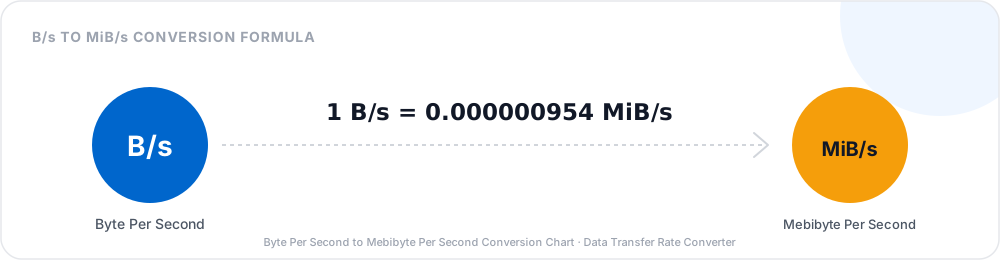
Byte Per Second to Mebibyte Per Second Conversion Examples
10 B/s = 0.000009536743164 MiB/s
50 B/s = 0.00004768371582 MiB/s
100 B/s = 0.000095367431641 MiB/s
500 B/s = 0.000476837158 MiB/s
1,000 B/s = 0.000953674316 MiB/s
Most data transfer rate units step by powers of ten: moving up the scale (bps → Kbps → Mbps → Gbps and beyond) means multiply by 1000, moving down means divide by 1000 — usually just a matter of shifting the decimal point. What's actually being counted underneath is bits: the binary digits, 0s and 1s, that make up every network signal.
What Is Byte Per Second (B/s)? Definition and Uses
One byte (8 bits) transferred per second. The fundamental byte-based transfer rate.
The byte per second is a byte-based throughput unit measuring data transfer speed, network bandwidth, or throughput capacity. Like the units used to measure file size, it's one of several data measurement units that scale using either decimal multiples of 1,000 (SI) or binary steps of 1,024 (IEC).
Common uses: File transfer displays, storage benchmarks, precise measurements
1 B/s = 8 bits per second .
The byte per second can be abbreviated as B/s; for example, 1 byte per second can be written as 1 B/s.
Byte Per Second Transfer Rate Unit at a Glance
| Unit type | byte-based throughput |
|---|---|
| Symbol | B/s |
| Common uses | File transfer displays, storage benchmarks, precise measurements |
What Is Mebibyte Per Second (MiB/s)? Definition and Uses
A mebibyte per second is 1,024 kibibytes per second. Binary equivalent of MB/s.
The mebibyte per second is a binary byte-based unit measuring data transfer speed, network bandwidth, or throughput capacity. Like the units used to measure file size, it's one of several data measurement units that scale using either decimal multiples of 1,000 (SI) or binary steps of 1,024 (IEC).
Common uses: Linux benchmarks, precise storage measurements, enterprise storage specs
1 MiB/s = 8 × 10⁶ bits per second .
The mebibyte per second can be abbreviated as MiB/s; for example, 1 mebibyte per second can be written as 1 MiB/s.
Mebibyte Per Second Transfer Rate Unit at a Glance
| Unit type | binary byte-based |
|---|---|
| Symbol | MiB/s |
| Common uses | Linux benchmarks, precise storage measurements, enterprise storage specs |
Byte Per Second to Mebibyte Per Second Conversion Table
The table below shows 100 byte per second measurements converted to mebibytes per second — scroll within the table to see the full range. Bookmark this reference table for quick lookups whenever you need to convert a value without shifting the decimal point by hand.
| Bytes Per Second | Mebibytes Per Second |
|---|---|
| 1 B/s | 0.000000953674 MiB/s |
| 13 B/s | 0.000012397766 MiB/s |
| 26 B/s | 0.000024795532 MiB/s |
| 39 B/s | 0.000037193298 MiB/s |
| 52 B/s | 0.000049591064 MiB/s |
| 65 B/s | 0.000061988831 MiB/s |
| 78 B/s | 0.000074386597 MiB/s |
| 91 B/s | 0.000086784363 MiB/s |
| 104 B/s | 0.000099182129 MiB/s |
| 117 B/s | 0.0001115799 MiB/s |
| 130 B/s | 0.0001239777 MiB/s |
| 143 B/s | 0.0001363754 MiB/s |
| 156 B/s | 0.0001487732 MiB/s |
| 169 B/s | 0.000161171 MiB/s |
| 182 B/s | 0.0001735687 MiB/s |
| 195 B/s | 0.0001859665 MiB/s |
| 208 B/s | 0.0001983643 MiB/s |
| 221 B/s | 0.000210762 MiB/s |
| 234 B/s | 0.0002231598 MiB/s |
| 247 B/s | 0.0002355576 MiB/s |
| 260 B/s | 0.0002479553 MiB/s |
| 273 B/s | 0.0002603531 MiB/s |
| 286 B/s | 0.0002727509 MiB/s |
| 299 B/s | 0.0002851486 MiB/s |
| 312 B/s | 0.0002975464 MiB/s |
| 325 B/s | 0.0003099442 MiB/s |
| 338 B/s | 0.0003223419 MiB/s |
| 351 B/s | 0.0003347397 MiB/s |
| 364 B/s | 0.0003471375 MiB/s |
| 377 B/s | 0.0003595352 MiB/s |
| 390 B/s | 0.000371933 MiB/s |
| 403 B/s | 0.0003843307 MiB/s |
| 416 B/s | 0.0003967285 MiB/s |
| 429 B/s | 0.0004091263 MiB/s |
| 442 B/s | 0.000421524 MiB/s |
| 455 B/s | 0.0004339218 MiB/s |
| 468 B/s | 0.0004463196 MiB/s |
| 481 B/s | 0.0004587173 MiB/s |
| 494 B/s | 0.0004711151 MiB/s |
| 507 B/s | 0.0004835129 MiB/s |
| 520 B/s | 0.0004959106 MiB/s |
| 533 B/s | 0.0005083084 MiB/s |
| 546 B/s | 0.0005207062 MiB/s |
| 559 B/s | 0.0005331039 MiB/s |
| 572 B/s | 0.0005455017 MiB/s |
| 585 B/s | 0.0005578995 MiB/s |
| 598 B/s | 0.0005702972 MiB/s |
| 611 B/s | 0.000582695 MiB/s |
| 624 B/s | 0.0005950928 MiB/s |
| 637 B/s | 0.0006074905 MiB/s |
| 650 B/s | 0.0006198883 MiB/s |
| 663 B/s | 0.0006322861 MiB/s |
| 676 B/s | 0.0006446838 MiB/s |
| 689 B/s | 0.0006570816 MiB/s |
| 702 B/s | 0.0006694794 MiB/s |
| 715 B/s | 0.0006818771 MiB/s |
| 728 B/s | 0.0006942749 MiB/s |
| 741 B/s | 0.0007066727 MiB/s |
| 754 B/s | 0.0007190704 MiB/s |
| 767 B/s | 0.0007314682 MiB/s |
| 780 B/s | 0.000743866 MiB/s |
| 793 B/s | 0.0007562637 MiB/s |
| 806 B/s | 0.0007686615 MiB/s |
| 819 B/s | 0.0007810593 MiB/s |
| 832 B/s | 0.000793457 MiB/s |
| 845 B/s | 0.0008058548 MiB/s |
| 858 B/s | 0.0008182526 MiB/s |
| 871 B/s | 0.0008306503 MiB/s |
| 884 B/s | 0.0008430481 MiB/s |
| 897 B/s | 0.0008554459 MiB/s |
| 910 B/s | 0.0008678436 MiB/s |
| 923 B/s | 0.0008802414 MiB/s |
| 936 B/s | 0.0008926392 MiB/s |
| 949 B/s | 0.0009050369 MiB/s |
| 962 B/s | 0.0009174347 MiB/s |
| 975 B/s | 0.0009298325 MiB/s |
| 988 B/s | 0.0009422302 MiB/s |
| 1,001 B/s | 0.000954628 MiB/s |
| 1,014 B/s | 0.0009670258 MiB/s |
| 1,027 B/s | 0.0009794235 MiB/s |
| 1,040 B/s | 0.0009918213 MiB/s |
| 1,053 B/s | 0.0010042191 MiB/s |
| 1,066 B/s | 0.0010166168 MiB/s |
| 1,079 B/s | 0.0010290146 MiB/s |
| 1,092 B/s | 0.0010414124 MiB/s |
| 1,105 B/s | 0.0010538101 MiB/s |
| 1,118 B/s | 0.0010662079 MiB/s |
| 1,131 B/s | 0.0010786057 MiB/s |
| 1,144 B/s | 0.0010910034 MiB/s |
| 1,157 B/s | 0.0011034012 MiB/s |
| 1,170 B/s | 0.001115799 MiB/s |
| 1,183 B/s | 0.0011281967 MiB/s |
| 1,196 B/s | 0.0011405945 MiB/s |
| 1,209 B/s | 0.0011529922 MiB/s |
| 1,222 B/s | 0.00116539 MiB/s |
| 1,235 B/s | 0.0011777878 MiB/s |
| 1,248 B/s | 0.0011901855 MiB/s |
| 1,261 B/s | 0.0012025833 MiB/s |
| 1,274 B/s | 0.0012149811 MiB/s |
| 1,287 B/s | 0.0012273788 MiB/s |
SI Decimal vs Binary: Why B/s to MiB/s Is Not a Round Number
Byte Per Second (B/s) is an SI decimal unit: each prefix step multiplies by 1,000, so 1 B/s = 8 bps. Mebibyte Per Second (MiB/s) is an IEC binary unit: each prefix step multiplies by 1,024, so 1 MiB/s = 8,388,608 bps. Dividing one by the other gives 0.000000953674316, which is why B/s to MiB/s is not a round number.
| Unit | Standard | Prefix step | 1 unit equals |
|---|---|---|---|
| Byte Per Second (B/s) | SI decimal | 1,000 | 8 bps |
| Mebibyte Per Second (MiB/s) | Binary (IEC) | 1,024 | 8,388,608 bps |
To compare like with like, use B/s to MB/s for SI decimal.
FAQs: Byte Per Second to Mebibyte Per Second Conversion
6 questions Quick answers on converting bytes per second to mebibytes per second, using the same factors as the converter above.
-
How many mebibytes per second are in 1 byte per second?
1 B/s = 0.000000953674316 MiB/s
1 Byte Per Second (B/s) equals 0.000000953674316 Mebibytes Per Second.
-
How many bytes per second are in 1 mebibyte per second?
1 MiB/s = 1,048,576 B/s
1 Mebibyte Per Second (MiB/s) equals 1,048,576 Bytes Per Second.
-
How do I convert bytes per second to mebibytes per second?
B/s × 0.000000953674316 = MiB/s
Multiply the byte per second value by 0.000000953674316 to get mebibytes per second. For example, 10 B/s = 0.000009536743164 MiB/s. To convert back (vice versa), multiply mebibytes per second by 1,048,576.
-
Is byte per second bigger than mebibyte per second?
MiB/s is 1,048,576× larger than B/s
No. 1 B/s = 0.000000953674316 MiB/s, so mebibyte per second is larger — 1 MiB/s = 1,048,576 B/s.
-
Why is B/s to MiB/s not a round number?
1 B/s = 8 bps · 1 MiB/s = 8,388,608 bps
Byte Per Second (B/s) is an SI decimal (base 10) unit and Mebibyte Per Second (MiB/s) is a binary IEC (base 2) unit, so their prefixes step by 1,000 and 1,024. That is why 1 B/s = 0.000000953674316 MiB/s instead of a round number.
-
What is Byte Per Second (B/s) commonly used for?
Common uses of the byte per second (B/s) include: File transfer displays, storage benchmarks, precise measurements.
Need another value? Use the B/s to MiB/s converter or convert MiB/s to B/s.