

1 B/s = 6.776264e-21 Zibps
Bytes Per Second to Zebibits Per Second Converter: B/s to Zibps Conversion Calculator
To convert bytes per second to zebibits per second (B/s to Zibps), enter your byte per second value in the From box and click the Convert button. Your zebibit per second result also appears in the To box as you type, mixing SI decimal and binary (IEC) prefixes and converting between bits and bytes. This free B/s to Zibps converter and conversion calculator also works vice versa: type in the To box to convert Zibps back to B/s, use Swap units to flip the pair, or Reset to start over.
Byte Per Second (B/s)
One byte (8 bits) transferred per second. The fundamental byte-based transfer rate.
View the byte per second data unit pageZebibit Per Second (Zibps)
A zebibit per second is 1,024 exbibits per second. Binary equivalent of Zbps.
View the zebibit per second data unit pageHow to Convert Bytes Per Second to Zebibits Per Second
To convert bytes per second to zebibits per second, multiply by 6.776264e-21. This conversion translates actual file transfer speeds (bytes) to network bandwidth (bits) by accounting for the 8:1 bit-to-byte ratio.
B/s represents your actual download or transfer speed—what you see in your browser or file manager when copying files.
Zibps is the equivalent network bandwidth. Use this when comparing against ISP plans, sizing network links, or calculating replication bandwidth requirements.
1 B/s = 6.776264e-21 Zibps — or equivalently, 1 Zibps = 1.475739525897e+20B/s.
B/s to Zibps transfer rate: 1 byte per second equals 6.776264e-21zebibits per second — the standard bandwidth conversion rate used by this data transfer calculator.
Quick Facts: B/s to Zibps Speed Conversion
- Conversion factor: 1 B/s = 6.776264e-21 Zibps
- Reverse factor: 1 Zibps = 1.475739525897e+20 B/s
- Source unit type: byte-based throughput
- Target unit type: binary bit-based
- Useful for: estimating download times, comparing advertised speeds, and network capacity planning
- Category: data transfer rate converter, network speed calculator, bandwidth converter
Steps to Convert Byte Per Second to Zebibit Per Second
- Enter your byte per second value (B/s) into the byte per second to zebibit per second converter above.
- The equivalent zebibits per second (Zibps) transfer speed appears instantly in the To box using the B/s to Zibps conversion factor; click the Convert button to recalculate and highlight the result.
- To convert zebibits per second back into bytes per second, type in the To box instead, or use the swap control to flip the pair.
B/s to Zibps Conversion Formula
Here's the exact B/s to Zibps formula in copy-paste-ready form — multiply by 6.776264e-21 to go from bytes per second to zebibits per second, or by 1.475739525897e+20 to reverse it — followed by a quick-reference chart of the same rate conversion.
// Convert B/s to Zibps
Zibps = B/s × 6.776264e-21

// Reverse: Convert Zibps to B/s
B/s = Zibps × 1.475739525897e+20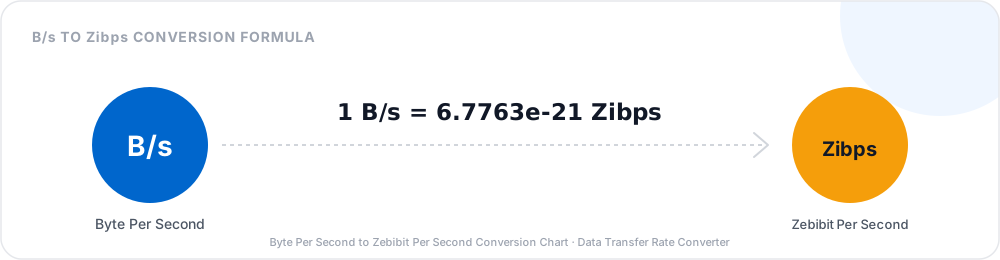
Byte Per Second to Zebibit Per Second Conversion Examples
10 B/s = 6.776264e-20 Zibps
50 B/s = 3.388132e-19 Zibps
100 B/s = 6.776264e-19 Zibps
500 B/s = 3.388132e-18 Zibps
1,000 B/s = 6.776264e-18 Zibps
Most data transfer rate units step by powers of ten: moving up the scale (bps → Kbps → Mbps → Gbps and beyond) means multiply by 1000, moving down means divide by 1000 — usually just a matter of shifting the decimal point. What's actually being counted underneath is bits: the binary digits, 0s and 1s, that make up every network signal.
What Is Byte Per Second (B/s)? Definition and Uses
One byte (8 bits) transferred per second. The fundamental byte-based transfer rate.
The byte per second is a byte-based throughput unit measuring data transfer speed, network bandwidth, or throughput capacity. Like the units used to measure file size, it's one of several data measurement units that scale using either decimal multiples of 1,000 (SI) or binary steps of 1,024 (IEC).
Common uses: File transfer displays, storage benchmarks, precise measurements
1 B/s = 8 bits per second .
The byte per second can be abbreviated as B/s; for example, 1 byte per second can be written as 1 B/s.
Byte Per Second Transfer Rate Unit at a Glance
| Unit type | byte-based throughput |
|---|---|
| Symbol | B/s |
| Common uses | File transfer displays, storage benchmarks, precise measurements |
What Is Zebibit Per Second (Zibps)? Definition and Uses
A zebibit per second is 1,024 exbibits per second. Binary equivalent of Zbps.
The zebibit per second is a binary bit-based unit measuring data transfer speed, network bandwidth, or throughput capacity. Like the units used to measure file size, it's one of several data measurement units that scale using either decimal multiples of 1,000 (SI) or binary steps of 1,024 (IEC).
Common uses: Theoretical binary bandwidth limits, future network projections, academic research
1 Zibps = 1 × 10²¹ bits per second .
The zebibit per second can be abbreviated as Zibps; for example, 1 zebibit per second can be written as 1 Zibps.
Don't confuse Zibps with ZiB/s (Zebibyte Per Second) — capitalization matters here. Zibps measures bits, ZiB/s measures bytes, and since 1 byte = 8 bits, 1 Zibps works out to just 0.125 ZiB/s using the same numeral.
Zebibit Per Second Transfer Rate Unit at a Glance
| Unit type | binary bit-based |
|---|---|
| Symbol | Zibps |
| Common uses | Theoretical binary bandwidth limits, future network projections, academic research |
Byte Per Second to Zebibit Per Second Conversion Table
The table below shows 100 byte per second measurements converted to zebibits per second — scroll within the table to see the full range. Bookmark this reference table for quick lookups whenever you need to convert a value without shifting the decimal point by hand.
| Bytes Per Second | Zebibits Per Second |
|---|---|
| 1 B/s | 6.7763e-21 Zibps |
| 13 B/s | 8.8091e-20 Zibps |
| 26 B/s | 1.7618e-19 Zibps |
| 39 B/s | 2.6427e-19 Zibps |
| 52 B/s | 3.5237e-19 Zibps |
| 65 B/s | 4.4046e-19 Zibps |
| 78 B/s | 5.2855e-19 Zibps |
| 91 B/s | 6.1664e-19 Zibps |
| 104 B/s | 7.0473e-19 Zibps |
| 117 B/s | 7.9282e-19 Zibps |
| 130 B/s | 8.8091e-19 Zibps |
| 143 B/s | 9.6901e-19 Zibps |
| 156 B/s | 1.0571e-18 Zibps |
| 169 B/s | 1.1452e-18 Zibps |
| 182 B/s | 1.2333e-18 Zibps |
| 195 B/s | 1.3214e-18 Zibps |
| 208 B/s | 1.4095e-18 Zibps |
| 221 B/s | 1.4976e-18 Zibps |
| 234 B/s | 1.5856e-18 Zibps |
| 247 B/s | 1.6737e-18 Zibps |
| 260 B/s | 1.7618e-18 Zibps |
| 273 B/s | 1.8499e-18 Zibps |
| 286 B/s | 1.9380e-18 Zibps |
| 299 B/s | 2.0261e-18 Zibps |
| 312 B/s | 2.1142e-18 Zibps |
| 325 B/s | 2.2023e-18 Zibps |
| 338 B/s | 2.2904e-18 Zibps |
| 351 B/s | 2.3785e-18 Zibps |
| 364 B/s | 2.4666e-18 Zibps |
| 377 B/s | 2.5547e-18 Zibps |
| 390 B/s | 2.6427e-18 Zibps |
| 403 B/s | 2.7308e-18 Zibps |
| 416 B/s | 2.8189e-18 Zibps |
| 429 B/s | 2.9070e-18 Zibps |
| 442 B/s | 2.9951e-18 Zibps |
| 455 B/s | 3.0832e-18 Zibps |
| 468 B/s | 3.1713e-18 Zibps |
| 481 B/s | 3.2594e-18 Zibps |
| 494 B/s | 3.3475e-18 Zibps |
| 507 B/s | 3.4356e-18 Zibps |
| 520 B/s | 3.5237e-18 Zibps |
| 533 B/s | 3.6117e-18 Zibps |
| 546 B/s | 3.6998e-18 Zibps |
| 559 B/s | 3.7879e-18 Zibps |
| 572 B/s | 3.8760e-18 Zibps |
| 585 B/s | 3.9641e-18 Zibps |
| 598 B/s | 4.0522e-18 Zibps |
| 611 B/s | 4.1403e-18 Zibps |
| 624 B/s | 4.2284e-18 Zibps |
| 637 B/s | 4.3165e-18 Zibps |
| 650 B/s | 4.4046e-18 Zibps |
| 663 B/s | 4.4927e-18 Zibps |
| 676 B/s | 4.5808e-18 Zibps |
| 689 B/s | 4.6688e-18 Zibps |
| 702 B/s | 4.7569e-18 Zibps |
| 715 B/s | 4.8450e-18 Zibps |
| 728 B/s | 4.9331e-18 Zibps |
| 741 B/s | 5.0212e-18 Zibps |
| 754 B/s | 5.1093e-18 Zibps |
| 767 B/s | 5.1974e-18 Zibps |
| 780 B/s | 5.2855e-18 Zibps |
| 793 B/s | 5.3736e-18 Zibps |
| 806 B/s | 5.4617e-18 Zibps |
| 819 B/s | 5.5498e-18 Zibps |
| 832 B/s | 5.6379e-18 Zibps |
| 845 B/s | 5.7259e-18 Zibps |
| 858 B/s | 5.8140e-18 Zibps |
| 871 B/s | 5.9021e-18 Zibps |
| 884 B/s | 5.9902e-18 Zibps |
| 897 B/s | 6.0783e-18 Zibps |
| 910 B/s | 6.1664e-18 Zibps |
| 923 B/s | 6.2545e-18 Zibps |
| 936 B/s | 6.3426e-18 Zibps |
| 949 B/s | 6.4307e-18 Zibps |
| 962 B/s | 6.5188e-18 Zibps |
| 975 B/s | 6.6069e-18 Zibps |
| 988 B/s | 6.6949e-18 Zibps |
| 1,001 B/s | 6.7830e-18 Zibps |
| 1,014 B/s | 6.8711e-18 Zibps |
| 1,027 B/s | 6.9592e-18 Zibps |
| 1,040 B/s | 7.0473e-18 Zibps |
| 1,053 B/s | 7.1354e-18 Zibps |
| 1,066 B/s | 7.2235e-18 Zibps |
| 1,079 B/s | 7.3116e-18 Zibps |
| 1,092 B/s | 7.3997e-18 Zibps |
| 1,105 B/s | 7.4878e-18 Zibps |
| 1,118 B/s | 7.5759e-18 Zibps |
| 1,131 B/s | 7.6640e-18 Zibps |
| 1,144 B/s | 7.7520e-18 Zibps |
| 1,157 B/s | 7.8401e-18 Zibps |
| 1,170 B/s | 7.9282e-18 Zibps |
| 1,183 B/s | 8.0163e-18 Zibps |
| 1,196 B/s | 8.1044e-18 Zibps |
| 1,209 B/s | 8.1925e-18 Zibps |
| 1,222 B/s | 8.2806e-18 Zibps |
| 1,235 B/s | 8.3687e-18 Zibps |
| 1,248 B/s | 8.4568e-18 Zibps |
| 1,261 B/s | 8.5449e-18 Zibps |
| 1,274 B/s | 8.6330e-18 Zibps |
| 1,287 B/s | 8.7211e-18 Zibps |
SI Decimal vs Binary: Why B/s to Zibps Is Not a Round Number
Byte Per Second (B/s) is an SI decimal unit: each prefix step multiplies by 1,000, so 1 B/s = 8 bps. Zebibit Per Second (Zibps) is an IEC binary unit: each prefix step multiplies by 1,024, so 1 Zibps = 1.181 × 10²¹ bps. Dividing one by the other gives 6.776264e-21, which is why B/s to Zibps is not a round number. Because one unit counts bits and the other bytes, the factor also includes a factor of 8.
| Unit | Standard | Prefix step | 1 unit equals |
|---|---|---|---|
| Byte Per Second (B/s) | SI decimal | 1,000 | 8 bps |
| Zebibit Per Second (Zibps) | Binary (IEC) | 1,024 | 1.181 × 10²¹ bps |
To compare like with like, use B/s to Zbps for SI decimal.
FAQs: Byte Per Second to Zebibit Per Second Conversion
6 questions Quick answers on converting bytes per second to zebibits per second, using the same factors as the converter above.
-
How many zebibits per second are in 1 byte per second?
1 Byte Per Second (B/s) equals 6.776264e-21 Zebibits Per Second.
-
How many bytes per second are in 1 zebibit per second?
1 Zebibit Per Second (Zibps) equals 1.475739525897e+20 Bytes Per Second.
-
How do I convert bytes per second to zebibits per second?
Multiply the byte per second value by 6.776264e-21 to get zebibits per second. For example, 10 B/s = 6.776264e-20 Zibps. To convert back (vice versa), multiply zebibits per second by 1.475739525897e+20.
-
What is the difference between bytes per second and zebibits per second?
B/s measures actual transfer throughput in bytes per second, while Zibps measures network bandwidth in bits per second. Divide bits by 8 to get bytes.
-
Why is B/s to Zibps not a round number?
1 B/s = 8 bps · 1 Zibps = 1.181 × 10²¹ bps
Byte Per Second (B/s) is an SI decimal (base 10) unit and Zebibit Per Second (Zibps) is a binary IEC (base 2) unit, so their prefixes step by 1,000 and 1,024. That is why 1 B/s = 6.776264e-21 Zibps instead of a round number. Because one unit counts bits and the other bytes, the factor also includes a factor of 8.
-
What is Byte Per Second (B/s) commonly used for?
Common uses of the byte per second (B/s) include: File transfer displays, storage benchmarks, precise measurements.
Need another value? Use the B/s to Zibps converter or convert Zibps to B/s.