

1 Eibps = 0.000001152921505 Ybps
Exbibits Per Second to Yottabits Per Second Converter: Eibps to Ybps Conversion Calculator
To convert exbibits per second to yottabits per second (Eibps to Ybps), enter your exbibit per second value in the From box and click the Convert button. Your yottabit per second result also appears in the To box as you type, mixing SI decimal and binary (IEC) prefixes. This free Eibps to Ybps converter and conversion calculator also works vice versa: type in the To box to convert Ybps back to Eibps, use Swap units to flip the pair, or Reset to start over.
Exbibit Per Second (Eibps)
An exbibit per second is 1,024 pebibits per second. Binary equivalent of Ebps.
View the exbibit per second data unit pageYottabit Per Second (Ybps)
A yottabit per second is 1,000 zettabits per second. The largest SI unit for data transfer rates.
View the yottabit per second data unit pageHow to Convert Exbibits Per Second to Yottabits Per Second
To convert exbibits per second to yottabits per second, divide by 867,361.737988. Both units measure network bandwidth in bits per second—the difference is simply the scale.
Eibps: An exbibit per second is 1,024 pebibits per second. Binary equivalent of Ebps. Common uses include Theoretical binary bandwidth, global capacity projections, academic research.
Ybps: A yottabit per second is 1,000 zettabits per second. The largest SI unit for data transfer rates. Typically used for Theoretical capacity limits, far-future projections, academic discussions.
1 Eibps = 0.000001152921505 Ybps — or equivalently, 1 Ybps = 867,361.737988Eibps.
Eibps to Ybps transfer rate: 1 exbibit per second equals 0.000001152921505yottabits per second — the standard bandwidth conversion rate used by this data transfer calculator.
Quick Facts: Eibps to Ybps Speed Conversion
- Conversion factor: 1 Eibps = 0.000001152921505 Ybps
- Reverse factor: 1 Ybps = 867,361.737988 Eibps
- Source unit type: binary bit-based
- Target unit type: bit-based bandwidth
- Useful for: estimating download times, comparing advertised speeds, and network capacity planning
- Category: data transfer rate converter, network speed calculator, bandwidth converter
Steps to Convert Exbibit Per Second to Yottabit Per Second
- Enter your exbibit per second value (Eibps) into the exbibit per second to yottabit per second converter above.
- The equivalent yottabits per second (Ybps) transfer speed appears instantly in the To box using the Eibps to Ybps conversion factor; click the Convert button to recalculate and highlight the result.
- To convert yottabits per second back into exbibits per second, type in the To box instead, or use the swap control to flip the pair.
Eibps to Ybps Conversion Formula
Here's the exact Eibps to Ybps formula in copy-paste-ready form — multiply by 0.000001152921505 to go from exbibits per second to yottabits per second, or by 867,361.737988 to reverse it — followed by a quick-reference chart of the same rate conversion.
// Convert Eibps to Ybps
Ybps = Eibps × 0.000001152921505

// Reverse: Convert Ybps to Eibps
Eibps = Ybps × 867,361.737988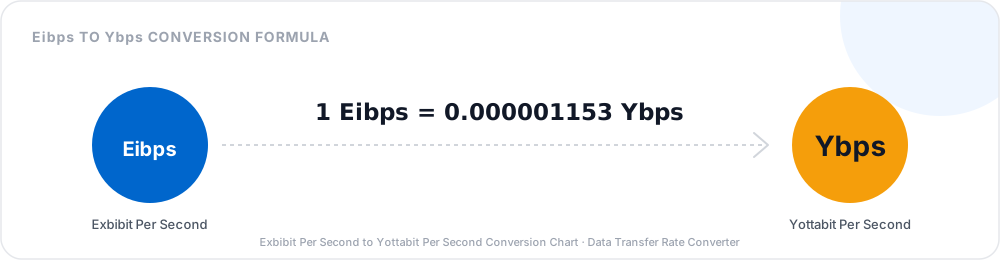
Exbibit Per Second to Yottabit Per Second Conversion Examples
10 Eibps = 0.000011529215046 Ybps
50 Eibps = 0.00005764607523 Ybps
100 Eibps = 0.00011529215 Ybps
500 Eibps = 0.000576460752 Ybps
1,000 Eibps = 0.001152921505 Ybps
Most data transfer rate units step by powers of ten: moving up the scale (bps → Kbps → Mbps → Gbps and beyond) means multiply by 1000, moving down means divide by 1000 — usually just a matter of shifting the decimal point. What's actually being counted underneath is bits: the binary digits, 0s and 1s, that make up every network signal.
What Is Exbibit Per Second (Eibps)? Definition and Uses
An exbibit per second is 1,024 pebibits per second. Binary equivalent of Ebps.
The exbibit per second is a binary bit-based unit measuring data transfer speed, network bandwidth, or throughput capacity. Like the units used to measure file size, it's one of several data measurement units that scale using either decimal multiples of 1,000 (SI) or binary steps of 1,024 (IEC).
Common uses: Theoretical binary bandwidth, global capacity projections, academic research
1 Eibps = 1 × 10¹⁸ bits per second .
The exbibit per second can be abbreviated as Eibps; for example, 1 exbibit per second can be written as 1 Eibps.
Don't confuse Eibps with EiB/s (Exbibyte Per Second) — capitalization matters here. Eibps measures bits, EiB/s measures bytes, and since 1 byte = 8 bits, 1 Eibps works out to just 0.125 EiB/s using the same numeral.
Exbibit Per Second Transfer Rate Unit at a Glance
| Unit type | binary bit-based |
|---|---|
| Symbol | Eibps |
| Common uses | Theoretical binary bandwidth, global capacity projections, academic research |
What Is Yottabit Per Second (Ybps)? Definition and Uses
A yottabit per second is 1,000 zettabits per second. The largest SI unit for data transfer rates.
The yottabit per second is a bit-based bandwidth unit measuring data transfer speed, network bandwidth, or throughput capacity. Like the units used to measure file size, it's one of several data measurement units that scale using either decimal multiples of 1,000 (SI) or binary steps of 1,024 (IEC).
Common uses: Theoretical capacity limits, far-future projections, academic discussions
1 Ybps = 1 × 10²⁴ bits per second .
The yottabit per second can be abbreviated as Ybps; for example, 1 yottabit per second can be written as 1 Ybps.
Don't confuse Ybps with YB/s (Yottabyte Per Second) — capitalization matters here. Ybps measures bits, YB/s measures bytes, and since 1 byte = 8 bits, 1 Ybps works out to just 0.125 YB/s using the same numeral.
Yottabit Per Second Transfer Rate Unit at a Glance
| Unit type | bit-based bandwidth |
|---|---|
| Symbol | Ybps |
| Common uses | Theoretical capacity limits, far-future projections, academic discussions |
Exbibit Per Second to Yottabit Per Second Conversion Table
The table below shows 100 exbibit per second measurements converted to yottabits per second — scroll within the table to see the full range. Bookmark this reference table for quick lookups whenever you need to convert a value without shifting the decimal point by hand.
| Exbibits Per Second | Yottabits Per Second |
|---|---|
| 1 Eibps | 0.000001152922 Ybps |
| 13 Eibps | 0.00001498798 Ybps |
| 26 Eibps | 0.000029975959 Ybps |
| 39 Eibps | 0.000044963939 Ybps |
| 52 Eibps | 0.000059951918 Ybps |
| 65 Eibps | 0.000074939898 Ybps |
| 78 Eibps | 0.000089927877 Ybps |
| 91 Eibps | 0.0001049159 Ybps |
| 104 Eibps | 0.0001199038 Ybps |
| 117 Eibps | 0.0001348918 Ybps |
| 130 Eibps | 0.0001498798 Ybps |
| 143 Eibps | 0.0001648678 Ybps |
| 156 Eibps | 0.0001798558 Ybps |
| 169 Eibps | 0.0001948437 Ybps |
| 182 Eibps | 0.0002098317 Ybps |
| 195 Eibps | 0.0002248197 Ybps |
| 208 Eibps | 0.0002398077 Ybps |
| 221 Eibps | 0.0002547957 Ybps |
| 234 Eibps | 0.0002697836 Ybps |
| 247 Eibps | 0.0002847716 Ybps |
| 260 Eibps | 0.0002997596 Ybps |
| 273 Eibps | 0.0003147476 Ybps |
| 286 Eibps | 0.0003297356 Ybps |
| 299 Eibps | 0.0003447235 Ybps |
| 312 Eibps | 0.0003597115 Ybps |
| 325 Eibps | 0.0003746995 Ybps |
| 338 Eibps | 0.0003896875 Ybps |
| 351 Eibps | 0.0004046754 Ybps |
| 364 Eibps | 0.0004196634 Ybps |
| 377 Eibps | 0.0004346514 Ybps |
| 390 Eibps | 0.0004496394 Ybps |
| 403 Eibps | 0.0004646274 Ybps |
| 416 Eibps | 0.0004796153 Ybps |
| 429 Eibps | 0.0004946033 Ybps |
| 442 Eibps | 0.0005095913 Ybps |
| 455 Eibps | 0.0005245793 Ybps |
| 468 Eibps | 0.0005395673 Ybps |
| 481 Eibps | 0.0005545552 Ybps |
| 494 Eibps | 0.0005695432 Ybps |
| 507 Eibps | 0.0005845312 Ybps |
| 520 Eibps | 0.0005995192 Ybps |
| 533 Eibps | 0.0006145072 Ybps |
| 546 Eibps | 0.0006294951 Ybps |
| 559 Eibps | 0.0006444831 Ybps |
| 572 Eibps | 0.0006594711 Ybps |
| 585 Eibps | 0.0006744591 Ybps |
| 598 Eibps | 0.0006894471 Ybps |
| 611 Eibps | 0.000704435 Ybps |
| 624 Eibps | 0.000719423 Ybps |
| 637 Eibps | 0.000734411 Ybps |
| 650 Eibps | 0.000749399 Ybps |
| 663 Eibps | 0.000764387 Ybps |
| 676 Eibps | 0.0007793749 Ybps |
| 689 Eibps | 0.0007943629 Ybps |
| 702 Eibps | 0.0008093509 Ybps |
| 715 Eibps | 0.0008243389 Ybps |
| 728 Eibps | 0.0008393269 Ybps |
| 741 Eibps | 0.0008543148 Ybps |
| 754 Eibps | 0.0008693028 Ybps |
| 767 Eibps | 0.0008842908 Ybps |
| 780 Eibps | 0.0008992788 Ybps |
| 793 Eibps | 0.0009142668 Ybps |
| 806 Eibps | 0.0009292547 Ybps |
| 819 Eibps | 0.0009442427 Ybps |
| 832 Eibps | 0.0009592307 Ybps |
| 845 Eibps | 0.0009742187 Ybps |
| 858 Eibps | 0.0009892067 Ybps |
| 871 Eibps | 0.0010041946 Ybps |
| 884 Eibps | 0.0010191826 Ybps |
| 897 Eibps | 0.0010341706 Ybps |
| 910 Eibps | 0.0010491586 Ybps |
| 923 Eibps | 0.0010641465 Ybps |
| 936 Eibps | 0.0010791345 Ybps |
| 949 Eibps | 0.0010941225 Ybps |
| 962 Eibps | 0.0011091105 Ybps |
| 975 Eibps | 0.0011240985 Ybps |
| 988 Eibps | 0.0011390864 Ybps |
| 1,001 Eibps | 0.0011540744 Ybps |
| 1,014 Eibps | 0.0011690624 Ybps |
| 1,027 Eibps | 0.0011840504 Ybps |
| 1,040 Eibps | 0.0011990384 Ybps |
| 1,053 Eibps | 0.0012140263 Ybps |
| 1,066 Eibps | 0.0012290143 Ybps |
| 1,079 Eibps | 0.0012440023 Ybps |
| 1,092 Eibps | 0.0012589903 Ybps |
| 1,105 Eibps | 0.0012739783 Ybps |
| 1,118 Eibps | 0.0012889662 Ybps |
| 1,131 Eibps | 0.0013039542 Ybps |
| 1,144 Eibps | 0.0013189422 Ybps |
| 1,157 Eibps | 0.0013339302 Ybps |
| 1,170 Eibps | 0.0013489182 Ybps |
| 1,183 Eibps | 0.0013639061 Ybps |
| 1,196 Eibps | 0.0013788941 Ybps |
| 1,209 Eibps | 0.0013938821 Ybps |
| 1,222 Eibps | 0.0014088701 Ybps |
| 1,235 Eibps | 0.0014238581 Ybps |
| 1,248 Eibps | 0.001438846 Ybps |
| 1,261 Eibps | 0.001453834 Ybps |
| 1,274 Eibps | 0.001468822 Ybps |
| 1,287 Eibps | 0.00148381 Ybps |
SI Decimal vs Binary: Why Eibps to Ybps Is Not a Round Number
Yottabit Per Second (Ybps) is an SI decimal unit: each prefix step multiplies by 1,000, so 1 Ybps = 1.000 × 10²⁴ bps. Exbibit Per Second (Eibps) is an IEC binary unit: each prefix step multiplies by 1,024, so 1 Eibps = 1.153 × 10¹⁸ bps. Dividing one by the other gives 0.000001152921505, which is why Eibps to Ybps is not a round number.
| Unit | Standard | Prefix step | 1 unit equals |
|---|---|---|---|
| Exbibit Per Second (Eibps) | Binary (IEC) | 1,024 | 1.153 × 10¹⁸ bps |
| Yottabit Per Second (Ybps) | SI decimal | 1,000 | 1.000 × 10²⁴ bps |
To compare like with like, use Ebps to Ybps for SI decimal or Eibps to Yibps for binary (IEC).
FAQs: Exbibit Per Second to Yottabit Per Second Conversion
6 questions Quick answers on converting exbibits per second to yottabits per second, using the same factors as the converter above.
-
How many yottabits per second are in 1 exbibit per second?
1 Eibps = 0.000001152921505 Ybps
1 Exbibit Per Second (Eibps) equals 0.000001152921505 Yottabits Per Second.
-
How many exbibits per second are in 1 yottabit per second?
1 Ybps = 867,361.737988 Eibps
1 Yottabit Per Second (Ybps) equals 867,361.737988 Exbibits Per Second.
-
How do I convert exbibits per second to yottabits per second?
Eibps × 0.000001152921505 = Ybps
Multiply the exbibit per second value by 0.000001152921505 to get yottabits per second. For example, 10 Eibps = 0.000011529215046 Ybps. To convert back (vice versa), multiply yottabits per second by 867,361.737988.
-
Is exbibit per second bigger than yottabit per second?
Ybps is 867,361.737988× larger than Eibps
No. 1 Eibps = 0.000001152921505 Ybps, so yottabit per second is larger — 1 Ybps = 867,361.737988 Eibps.
-
Why is Eibps to Ybps not a round number?
1 Ybps = 1.000 × 10²⁴ bps · 1 Eibps = 1.153 × 10¹⁸ bps
Yottabit Per Second (Ybps) is an SI decimal (base 10) unit and Exbibit Per Second (Eibps) is a binary IEC (base 2) unit, so their prefixes step by 1,000 and 1,024. That is why 1 Eibps = 0.000001152921505 Ybps instead of a round number.
-
What is Exbibit Per Second (Eibps) commonly used for?
Common uses of the exbibit per second (Eibps) include: Theoretical binary bandwidth, global capacity projections, academic research.
Need another value? Use the Eibps to Ybps converter or convert Ybps to Eibps.