

1 Eibps = 0.000144115188 ZB/s
Exbibits Per Second to Zettabytes Per Second Converter: Eibps to ZB/s Conversion Calculator
To convert exbibits per second to zettabytes per second (Eibps to ZB/s), enter your exbibit per second value in the From box and click the Convert button. Your zettabyte per second result also appears in the To box as you type, mixing SI decimal and binary (IEC) prefixes and converting between bits and bytes. This free Eibps to ZB/s converter and conversion calculator also works vice versa: type in the To box to convert ZB/s back to Eibps, use Swap units to flip the pair, or Reset to start over.
Exbibit Per Second (Eibps)
An exbibit per second is 1,024 pebibits per second. Binary equivalent of Ebps.
View the exbibit per second data unit pageZettabyte Per Second (ZB/s)
A zettabyte per second is 1,000 exabytes per second. Theoretical unit for future computing capacity.
View the zettabyte per second data unit pageHow to Convert Exbibits Per Second to Zettabytes Per Second
To convert exbibits per second to zettabytes per second, divide by 6,938.893904 (or multiply by 0.000144115188). This conversion accounts for the 8:1 relationship between bits and bytes—network speeds are measured in bits, while file sizes use bytes.
Eibps is a binary bit-based commonly used for Theoretical binary bandwidth, global capacity projections, academic research. When you see your ISP advertise speeds in Eibps, this is the raw network bandwidth.
ZB/s is what you actually experience when downloading files. Your browser, torrent client, or download manager shows speeds in ZB/s because that's how fast data is being written to your storage.
1 Eibps = 0.000144115188 ZB/s — or equivalently, 1 ZB/s = 6,938.893904Eibps.
Eibps to ZB/s transfer rate: 1 exbibit per second equals 0.000144115188zettabytes per second — the standard bandwidth conversion rate used by this data transfer calculator.
Quick Facts: Eibps to ZB/s Speed Conversion
- Conversion factor: 1 Eibps = 0.000144115188 ZB/s
- Reverse factor: 1 ZB/s = 6,938.893904 Eibps
- Source unit type: binary bit-based
- Target unit type: byte-based throughput
- Useful for: estimating download times, comparing advertised speeds, and network capacity planning
- Category: data transfer rate converter, network speed calculator, bandwidth converter
Steps to Convert Exbibit Per Second to Zettabyte Per Second
- Enter your exbibit per second value (Eibps) into the exbibit per second to zettabyte per second converter above.
- The equivalent zettabytes per second (ZB/s) transfer speed appears instantly in the To box using the Eibps to ZB/s conversion factor; click the Convert button to recalculate and highlight the result.
- To convert zettabytes per second back into exbibits per second, type in the To box instead, or use the swap control to flip the pair.
Eibps to ZB/s Conversion Formula
Here's the exact Eibps to ZB/s formula in copy-paste-ready form — multiply by 0.000144115188 to go from exbibits per second to zettabytes per second, or by 6,938.893904 to reverse it — followed by a quick-reference chart of the same rate conversion.
// Convert Eibps to ZB/s
ZB/s = Eibps × 0.000144115188

// Reverse: Convert ZB/s to Eibps
Eibps = ZB/s × 6,938.893904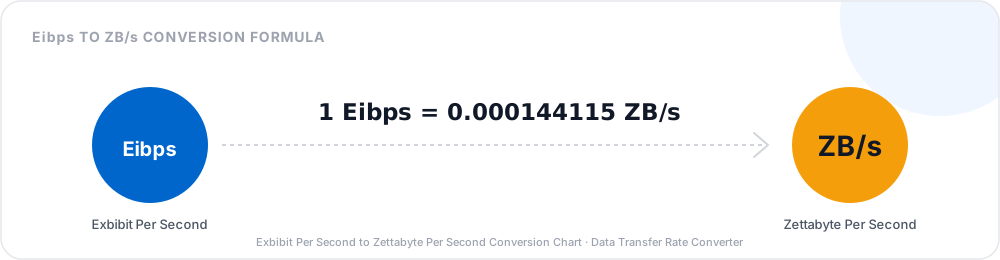
Exbibit Per Second to Zettabyte Per Second Conversion Examples
10 Eibps = 0.001441151881 ZB/s
50 Eibps = 0.007205759404 ZB/s
100 Eibps = 0.014411518808 ZB/s
500 Eibps = 0.072057594038 ZB/s
1,000 Eibps = 0.144115188076 ZB/s
Most data transfer rate units step by powers of ten: moving up the scale (bps → Kbps → Mbps → Gbps and beyond) means multiply by 1000, moving down means divide by 1000 — usually just a matter of shifting the decimal point. What's actually being counted underneath is bits: the binary digits, 0s and 1s, that make up every network signal.
What Is Exbibit Per Second (Eibps)? Definition and Uses
An exbibit per second is 1,024 pebibits per second. Binary equivalent of Ebps.
The exbibit per second is a binary bit-based unit measuring data transfer speed, network bandwidth, or throughput capacity. Like the units used to measure file size, it's one of several data measurement units that scale using either decimal multiples of 1,000 (SI) or binary steps of 1,024 (IEC).
Common uses: Theoretical binary bandwidth, global capacity projections, academic research
1 Eibps = 1 × 10¹⁸ bits per second .
The exbibit per second can be abbreviated as Eibps; for example, 1 exbibit per second can be written as 1 Eibps.
Don't confuse Eibps with EiB/s (Exbibyte Per Second) — capitalization matters here. Eibps measures bits, EiB/s measures bytes, and since 1 byte = 8 bits, 1 Eibps works out to just 0.125 EiB/s using the same numeral.
Exbibit Per Second Transfer Rate Unit at a Glance
| Unit type | binary bit-based |
|---|---|
| Symbol | Eibps |
| Common uses | Theoretical binary bandwidth, global capacity projections, academic research |
What Is Zettabyte Per Second (ZB/s)? Definition and Uses
A zettabyte per second is 1,000 exabytes per second. Theoretical unit for future computing capacity.
The zettabyte per second is a byte-based throughput unit measuring data transfer speed, network bandwidth, or throughput capacity. Like the units used to measure file size, it's one of several data measurement units that scale using either decimal multiples of 1,000 (SI) or binary steps of 1,024 (IEC).
Common uses: Theoretical capacity limits, future computing projections, academic research
1 ZB/s = 8 × 10²¹ bits per second .
The zettabyte per second can be abbreviated as ZB/s; for example, 1 zettabyte per second can be written as 1 ZB/s.
Zettabyte Per Second Transfer Rate Unit at a Glance
| Unit type | byte-based throughput |
|---|---|
| Symbol | ZB/s |
| Common uses | Theoretical capacity limits, future computing projections, academic research |
Exbibit Per Second to Zettabyte Per Second Conversion Table
The table below shows 100 exbibit per second measurements converted to zettabytes per second — scroll within the table to see the full range. Bookmark this reference table for quick lookups whenever you need to convert a value without shifting the decimal point by hand.
| Exbibits Per Second | Zettabytes Per Second |
|---|---|
| 1 Eibps | 0.0001441152 ZB/s |
| 13 Eibps | 0.0018734974 ZB/s |
| 26 Eibps | 0.0037469949 ZB/s |
| 39 Eibps | 0.0056204923 ZB/s |
| 52 Eibps | 0.0074939898 ZB/s |
| 65 Eibps | 0.0093674872 ZB/s |
| 78 Eibps | 0.0112409847 ZB/s |
| 91 Eibps | 0.0131144821 ZB/s |
| 104 Eibps | 0.0149879796 ZB/s |
| 117 Eibps | 0.016861477 ZB/s |
| 130 Eibps | 0.0187349744 ZB/s |
| 143 Eibps | 0.0206084719 ZB/s |
| 156 Eibps | 0.0224819693 ZB/s |
| 169 Eibps | 0.0243554668 ZB/s |
| 182 Eibps | 0.0262289642 ZB/s |
| 195 Eibps | 0.0281024617 ZB/s |
| 208 Eibps | 0.0299759591 ZB/s |
| 221 Eibps | 0.0318494566 ZB/s |
| 234 Eibps | 0.033722954 ZB/s |
| 247 Eibps | 0.0355964515 ZB/s |
| 260 Eibps | 0.0374699489 ZB/s |
| 273 Eibps | 0.0393434463 ZB/s |
| 286 Eibps | 0.0412169438 ZB/s |
| 299 Eibps | 0.0430904412 ZB/s |
| 312 Eibps | 0.0449639387 ZB/s |
| 325 Eibps | 0.0468374361 ZB/s |
| 338 Eibps | 0.0487109336 ZB/s |
| 351 Eibps | 0.050584431 ZB/s |
| 364 Eibps | 0.0524579285 ZB/s |
| 377 Eibps | 0.0543314259 ZB/s |
| 390 Eibps | 0.0562049233 ZB/s |
| 403 Eibps | 0.0580784208 ZB/s |
| 416 Eibps | 0.0599519182 ZB/s |
| 429 Eibps | 0.0618254157 ZB/s |
| 442 Eibps | 0.0636989131 ZB/s |
| 455 Eibps | 0.0655724106 ZB/s |
| 468 Eibps | 0.067445908 ZB/s |
| 481 Eibps | 0.0693194055 ZB/s |
| 494 Eibps | 0.0711929029 ZB/s |
| 507 Eibps | 0.0730664004 ZB/s |
| 520 Eibps | 0.0749398978 ZB/s |
| 533 Eibps | 0.0768133952 ZB/s |
| 546 Eibps | 0.0786868927 ZB/s |
| 559 Eibps | 0.0805603901 ZB/s |
| 572 Eibps | 0.0824338876 ZB/s |
| 585 Eibps | 0.084307385 ZB/s |
| 598 Eibps | 0.0861808825 ZB/s |
| 611 Eibps | 0.0880543799 ZB/s |
| 624 Eibps | 0.0899278774 ZB/s |
| 637 Eibps | 0.0918013748 ZB/s |
| 650 Eibps | 0.0936748722 ZB/s |
| 663 Eibps | 0.0955483697 ZB/s |
| 676 Eibps | 0.0974218671 ZB/s |
| 689 Eibps | 0.0992953646 ZB/s |
| 702 Eibps | 0.101168862 ZB/s |
| 715 Eibps | 0.1030423595 ZB/s |
| 728 Eibps | 0.1049158569 ZB/s |
| 741 Eibps | 0.1067893544 ZB/s |
| 754 Eibps | 0.1086628518 ZB/s |
| 767 Eibps | 0.1105363493 ZB/s |
| 780 Eibps | 0.1124098467 ZB/s |
| 793 Eibps | 0.1142833441 ZB/s |
| 806 Eibps | 0.1161568416 ZB/s |
| 819 Eibps | 0.118030339 ZB/s |
| 832 Eibps | 0.1199038365 ZB/s |
| 845 Eibps | 0.1217773339 ZB/s |
| 858 Eibps | 0.1236508314 ZB/s |
| 871 Eibps | 0.1255243288 ZB/s |
| 884 Eibps | 0.1273978263 ZB/s |
| 897 Eibps | 0.1292713237 ZB/s |
| 910 Eibps | 0.1311448211 ZB/s |
| 923 Eibps | 0.1330183186 ZB/s |
| 936 Eibps | 0.134891816 ZB/s |
| 949 Eibps | 0.1367653135 ZB/s |
| 962 Eibps | 0.1386388109 ZB/s |
| 975 Eibps | 0.1405123084 ZB/s |
| 988 Eibps | 0.1423858058 ZB/s |
| 1,001 Eibps | 0.1442593033 ZB/s |
| 1,014 Eibps | 0.1461328007 ZB/s |
| 1,027 Eibps | 0.1480062982 ZB/s |
| 1,040 Eibps | 0.1498797956 ZB/s |
| 1,053 Eibps | 0.151753293 ZB/s |
| 1,066 Eibps | 0.1536267905 ZB/s |
| 1,079 Eibps | 0.1555002879 ZB/s |
| 1,092 Eibps | 0.1573737854 ZB/s |
| 1,105 Eibps | 0.1592472828 ZB/s |
| 1,118 Eibps | 0.1611207803 ZB/s |
| 1,131 Eibps | 0.1629942777 ZB/s |
| 1,144 Eibps | 0.1648677752 ZB/s |
| 1,157 Eibps | 0.1667412726 ZB/s |
| 1,170 Eibps | 0.16861477 ZB/s |
| 1,183 Eibps | 0.1704882675 ZB/s |
| 1,196 Eibps | 0.1723617649 ZB/s |
| 1,209 Eibps | 0.1742352624 ZB/s |
| 1,222 Eibps | 0.1761087598 ZB/s |
| 1,235 Eibps | 0.1779822573 ZB/s |
| 1,248 Eibps | 0.1798557547 ZB/s |
| 1,261 Eibps | 0.1817292522 ZB/s |
| 1,274 Eibps | 0.1836027496 ZB/s |
| 1,287 Eibps | 0.1854762471 ZB/s |
SI Decimal vs Binary: Why Eibps to ZB/s Is Not a Round Number
Zettabyte Per Second (ZB/s) is an SI decimal unit: each prefix step multiplies by 1,000, so 1 ZB/s = 8.000 × 10²¹ bps. Exbibit Per Second (Eibps) is an IEC binary unit: each prefix step multiplies by 1,024, so 1 Eibps = 1.153 × 10¹⁸ bps. Dividing one by the other gives 0.000144115188, which is why Eibps to ZB/s is not a round number. Because one unit counts bits and the other bytes, the factor also includes a factor of 8.
| Unit | Standard | Prefix step | 1 unit equals |
|---|---|---|---|
| Exbibit Per Second (Eibps) | Binary (IEC) | 1,024 | 1.153 × 10¹⁸ bps |
| Zettabyte Per Second (ZB/s) | SI decimal | 1,000 | 8.000 × 10²¹ bps |
To compare like with like, use Ebps to ZB/s for SI decimal or Eibps to ZiB/s for binary (IEC).
FAQs: Exbibit Per Second to Zettabyte Per Second Conversion
6 questions Quick answers on converting exbibits per second to zettabytes per second, using the same factors as the converter above.
-
How many zettabytes per second are in 1 exbibit per second?
1 Eibps = 0.000144115188 ZB/s
1 Exbibit Per Second (Eibps) equals 0.000144115188 Zettabytes Per Second.
-
How many exbibits per second are in 1 zettabyte per second?
1 ZB/s = 6,938.893904 Eibps
1 Zettabyte Per Second (ZB/s) equals 6,938.893904 Exbibits Per Second.
-
How do I convert exbibits per second to zettabytes per second?
Eibps × 0.000144115188 = ZB/s
Multiply the exbibit per second value by 0.000144115188 to get zettabytes per second. For example, 10 Eibps = 0.001441151881 ZB/s. To convert back (vice versa), multiply zettabytes per second by 6,938.893904.
-
What is the difference between exbibits per second and zettabytes per second?
Eibps measures network bandwidth in bits per second, while ZB/s measures actual transfer throughput in bytes per second. Divide bits by 8 to get bytes.
-
Why is Eibps to ZB/s not a round number?
1 ZB/s = 8.000 × 10²¹ bps · 1 Eibps = 1.153 × 10¹⁸ bps
Zettabyte Per Second (ZB/s) is an SI decimal (base 10) unit and Exbibit Per Second (Eibps) is a binary IEC (base 2) unit, so their prefixes step by 1,000 and 1,024. That is why 1 Eibps = 0.000144115188 ZB/s instead of a round number. Because one unit counts bits and the other bytes, the factor also includes a factor of 8.
-
What is Exbibit Per Second (Eibps) commonly used for?
Common uses of the exbibit per second (Eibps) include: Theoretical binary bandwidth, global capacity projections, academic research.
Need another value? Use the Eibps to ZB/s converter or convert ZB/s to Eibps.