

1 GB/s = 953.6743164063 MiB/s
Gigabytes Per Second to Mebibytes Per Second Converter: GB/s to MiB/s Conversion Calculator
To convert gigabytes per second to mebibytes per second (GB/s to MiB/s), enter your gigabyte per second value in the From box and click the Convert button. Your mebibyte per second result also appears in the To box as you type, mixing SI decimal and binary (IEC) prefixes. This free GB/s to MiB/s converter and conversion calculator also works vice versa: type in the To box to convert MiB/s back to GB/s, use Swap units to flip the pair, or Reset to start over.
Gigabyte Per Second (GB/s)
A gigabyte per second is 1,000 megabytes per second. Used for NVMe SSDs and high-speed storage.
View the gigabyte per second data unit pageMebibyte Per Second (MiB/s)
A mebibyte per second is 1,024 kibibytes per second. Binary equivalent of MB/s.
View the mebibyte per second data unit pageHow to Convert Gigabytes Per Second to Mebibytes Per Second
To convert gigabytes per second to mebibytes per second, multiply by 953.6743164063. Both units measure actual data throughput in bytes per second—useful for comparing storage benchmarks, file transfer speeds, and backup performance.
GB/s: A gigabyte per second is 1,000 megabytes per second. Used for NVMe SSDs and high-speed storage. Common uses include NVMe SSD speeds, PCIe bandwidth, high-performance computing, GPU memory.
MiB/s: A mebibyte per second is 1,024 kibibytes per second. Binary equivalent of MB/s. Typically used for Linux benchmarks, precise storage measurements, enterprise storage specs.
1 GB/s = 953.6743164063 MiB/s — which means there are 953.6743164063mebibytes per second in every gigabyte per second.
GB/s to MiB/s transfer rate: 1 gigabyte per second equals 953.6743164063mebibytes per second — the standard bandwidth conversion rate used by this data transfer calculator.
Quick Facts: GB/s to MiB/s Speed Conversion
- Conversion factor: 1 GB/s = 953.6743164063 MiB/s
- Reverse factor: 1 MiB/s = 0.001048576 GB/s
- Source unit type: byte-based throughput
- Target unit type: binary byte-based
- Useful for: estimating download times, comparing advertised speeds, and network capacity planning
- Category: data transfer rate converter, network speed calculator, bandwidth converter
Steps to Convert Gigabyte Per Second to Mebibyte Per Second
- Enter your gigabyte per second value (GB/s) into the gigabyte per second to mebibyte per second converter above.
- The equivalent mebibytes per second (MiB/s) transfer speed appears instantly in the To box using the GB/s to MiB/s conversion factor; click the Convert button to recalculate and highlight the result.
- To convert mebibytes per second back into gigabytes per second, type in the To box instead, or use the swap control to flip the pair.
GB/s to MiB/s Conversion Formula
Here's the exact GB/s to MiB/s formula in copy-paste-ready form — multiply by 953.6743164063 to go from gigabytes per second to mebibytes per second, or by 0.001048576 to reverse it — followed by a quick-reference chart of the same rate conversion.
// Convert GB/s to MiB/s
MiB/s = GB/s × 953.6743164063

// Reverse: Convert MiB/s to GB/s
GB/s = MiB/s × 0.001048576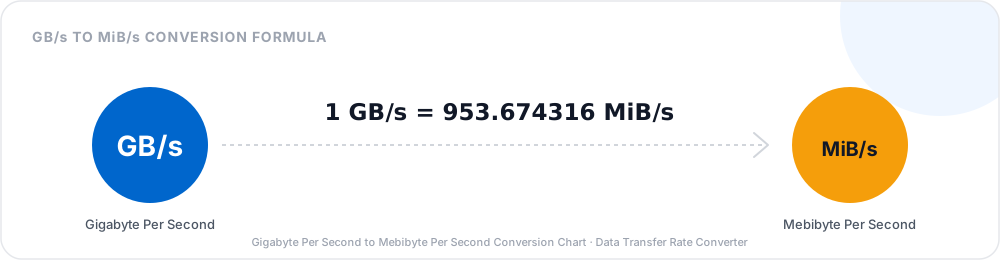
Gigabyte Per Second to Mebibyte Per Second Conversion Examples
10 GB/s = 9,536.743164 MiB/s
50 GB/s = 47,683.71582 MiB/s
100 GB/s = 95,367.431641 MiB/s
500 GB/s = 476,837.158203 MiB/s
1,000 GB/s = 953,674.316406 MiB/s
Most data transfer rate units step by powers of ten: moving up the scale (bps → Kbps → Mbps → Gbps and beyond) means multiply by 1000, moving down means divide by 1000 — usually just a matter of shifting the decimal point. What's actually being counted underneath is bits: the binary digits, 0s and 1s, that make up every network signal.
What Is Gigabyte Per Second (GB/s)? Definition and Uses
A gigabyte per second is 1,000 megabytes per second. Used for NVMe SSDs and high-speed storage.
The gigabyte per second is a byte-based throughput unit measuring data transfer speed, network bandwidth, or throughput capacity. Like the units used to measure file size, it's one of several data measurement units that scale using either decimal multiples of 1,000 (SI) or binary steps of 1,024 (IEC).
Common uses: NVMe SSD speeds, PCIe bandwidth, high-performance computing, GPU memory
1 GB/s = 8 × 10⁹ bits per second .
The gigabyte per second can be abbreviated as GB/s; for example, 1 gigabyte per second can be written as 1 GB/s.
Gigabyte Per Second Transfer Rate Unit at a Glance
| Unit type | byte-based throughput |
|---|---|
| Symbol | GB/s |
| Common uses | NVMe SSD speeds, PCIe bandwidth, high-performance computing, GPU memory |
What Is Mebibyte Per Second (MiB/s)? Definition and Uses
A mebibyte per second is 1,024 kibibytes per second. Binary equivalent of MB/s.
The mebibyte per second is a binary byte-based unit measuring data transfer speed, network bandwidth, or throughput capacity. Like the units used to measure file size, it's one of several data measurement units that scale using either decimal multiples of 1,000 (SI) or binary steps of 1,024 (IEC).
Common uses: Linux benchmarks, precise storage measurements, enterprise storage specs
1 MiB/s = 8 × 10⁶ bits per second .
The mebibyte per second can be abbreviated as MiB/s; for example, 1 mebibyte per second can be written as 1 MiB/s.
Mebibyte Per Second Transfer Rate Unit at a Glance
| Unit type | binary byte-based |
|---|---|
| Symbol | MiB/s |
| Common uses | Linux benchmarks, precise storage measurements, enterprise storage specs |
Gigabyte Per Second to Mebibyte Per Second Conversion Table
The table below shows 100 gigabyte per second measurements converted to mebibytes per second — scroll within the table to see the full range. Bookmark this reference table for quick lookups whenever you need to convert a value without shifting the decimal point by hand.
| Gigabytes Per Second | Mebibytes Per Second |
|---|---|
| 1 GB/s | 953.67431641 MiB/s |
| 13 GB/s | 12,397.76611328 MiB/s |
| 26 GB/s | 24,795.53222656 MiB/s |
| 39 GB/s | 37,193.29833984 MiB/s |
| 52 GB/s | 49,591.06445313 MiB/s |
| 65 GB/s | 61,988.83056641 MiB/s |
| 78 GB/s | 74,386.59667969 MiB/s |
| 91 GB/s | 86,784.36279297 MiB/s |
| 104 GB/s | 99,182.12890625 MiB/s |
| 117 GB/s | 111,579.89501953 MiB/s |
| 130 GB/s | 123,977.66113281 MiB/s |
| 143 GB/s | 136,375.42724609 MiB/s |
| 156 GB/s | 148,773.19335938 MiB/s |
| 169 GB/s | 161,170.95947266 MiB/s |
| 182 GB/s | 173,568.72558594 MiB/s |
| 195 GB/s | 185,966.49169922 MiB/s |
| 208 GB/s | 198,364.2578125 MiB/s |
| 221 GB/s | 210,762.02392578 MiB/s |
| 234 GB/s | 223,159.79003906 MiB/s |
| 247 GB/s | 235,557.55615234 MiB/s |
| 260 GB/s | 247,955.32226563 MiB/s |
| 273 GB/s | 260,353.08837891 MiB/s |
| 286 GB/s | 272,750.85449219 MiB/s |
| 299 GB/s | 285,148.62060547 MiB/s |
| 312 GB/s | 297,546.38671875 MiB/s |
| 325 GB/s | 309,944.15283203 MiB/s |
| 338 GB/s | 322,341.91894531 MiB/s |
| 351 GB/s | 334,739.68505859 MiB/s |
| 364 GB/s | 347,137.45117188 MiB/s |
| 377 GB/s | 359,535.21728516 MiB/s |
| 390 GB/s | 371,932.98339844 MiB/s |
| 403 GB/s | 384,330.74951172 MiB/s |
| 416 GB/s | 396,728.515625 MiB/s |
| 429 GB/s | 409,126.28173828 MiB/s |
| 442 GB/s | 421,524.04785156 MiB/s |
| 455 GB/s | 433,921.81396484 MiB/s |
| 468 GB/s | 446,319.58007813 MiB/s |
| 481 GB/s | 458,717.34619141 MiB/s |
| 494 GB/s | 471,115.11230469 MiB/s |
| 507 GB/s | 483,512.87841797 MiB/s |
| 520 GB/s | 495,910.64453125 MiB/s |
| 533 GB/s | 508,308.41064453 MiB/s |
| 546 GB/s | 520,706.17675781 MiB/s |
| 559 GB/s | 533,103.94287109 MiB/s |
| 572 GB/s | 545,501.70898438 MiB/s |
| 585 GB/s | 557,899.47509766 MiB/s |
| 598 GB/s | 570,297.24121094 MiB/s |
| 611 GB/s | 582,695.00732422 MiB/s |
| 624 GB/s | 595,092.7734375 MiB/s |
| 637 GB/s | 607,490.53955078 MiB/s |
| 650 GB/s | 619,888.30566406 MiB/s |
| 663 GB/s | 632,286.07177734 MiB/s |
| 676 GB/s | 644,683.83789063 MiB/s |
| 689 GB/s | 657,081.60400391 MiB/s |
| 702 GB/s | 669,479.37011719 MiB/s |
| 715 GB/s | 681,877.13623047 MiB/s |
| 728 GB/s | 694,274.90234375 MiB/s |
| 741 GB/s | 706,672.66845703 MiB/s |
| 754 GB/s | 719,070.43457031 MiB/s |
| 767 GB/s | 731,468.20068359 MiB/s |
| 780 GB/s | 743,865.96679688 MiB/s |
| 793 GB/s | 756,263.73291016 MiB/s |
| 806 GB/s | 768,661.49902344 MiB/s |
| 819 GB/s | 781,059.26513672 MiB/s |
| 832 GB/s | 793,457.03125 MiB/s |
| 845 GB/s | 805,854.79736328 MiB/s |
| 858 GB/s | 818,252.56347656 MiB/s |
| 871 GB/s | 830,650.32958984 MiB/s |
| 884 GB/s | 843,048.09570313 MiB/s |
| 897 GB/s | 855,445.86181641 MiB/s |
| 910 GB/s | 867,843.62792969 MiB/s |
| 923 GB/s | 880,241.39404297 MiB/s |
| 936 GB/s | 892,639.16015625 MiB/s |
| 949 GB/s | 905,036.92626953 MiB/s |
| 962 GB/s | 917,434.69238281 MiB/s |
| 975 GB/s | 929,832.45849609 MiB/s |
| 988 GB/s | 942,230.22460938 MiB/s |
| 1,001 GB/s | 954,627.99072266 MiB/s |
| 1,014 GB/s | 967,025.75683594 MiB/s |
| 1,027 GB/s | 979,423.52294922 MiB/s |
| 1,040 GB/s | 991,821.2890625 MiB/s |
| 1,053 GB/s | 1,004,219 MiB/s |
| 1,066 GB/s | 1,016,617 MiB/s |
| 1,079 GB/s | 1,029,015 MiB/s |
| 1,092 GB/s | 1,041,412 MiB/s |
| 1,105 GB/s | 1,053,810 MiB/s |
| 1,118 GB/s | 1,066,208 MiB/s |
| 1,131 GB/s | 1,078,606 MiB/s |
| 1,144 GB/s | 1,091,003 MiB/s |
| 1,157 GB/s | 1,103,401 MiB/s |
| 1,170 GB/s | 1,115,799 MiB/s |
| 1,183 GB/s | 1,128,197 MiB/s |
| 1,196 GB/s | 1,140,594 MiB/s |
| 1,209 GB/s | 1,152,992 MiB/s |
| 1,222 GB/s | 1,165,390 MiB/s |
| 1,235 GB/s | 1,177,788 MiB/s |
| 1,248 GB/s | 1,190,186 MiB/s |
| 1,261 GB/s | 1,202,583 MiB/s |
| 1,274 GB/s | 1,214,981 MiB/s |
| 1,287 GB/s | 1,227,379 MiB/s |
SI Decimal vs Binary: Why GB/s to MiB/s Is Not a Round Number
Gigabyte Per Second (GB/s) is an SI decimal unit: each prefix step multiplies by 1,000, so 1 GB/s = 8,000,000,000 bps. Mebibyte Per Second (MiB/s) is an IEC binary unit: each prefix step multiplies by 1,024, so 1 MiB/s = 8,388,608 bps. Dividing one by the other gives 953.6743164063, which is why GB/s to MiB/s is not a round number.
| Unit | Standard | Prefix step | 1 unit equals |
|---|---|---|---|
| Gigabyte Per Second (GB/s) | SI decimal | 1,000 | 8,000,000,000 bps |
| Mebibyte Per Second (MiB/s) | Binary (IEC) | 1,024 | 8,388,608 bps |
To compare like with like, use GB/s to MB/s for SI decimal or GiB/s to MiB/s for binary (IEC).
FAQs: Gigabyte Per Second to Mebibyte Per Second Conversion
6 questions Quick answers on converting gigabytes per second to mebibytes per second, using the same factors as the converter above.
-
How many mebibytes per second are in 1 gigabyte per second?
1 GB/s = 953.6743164063 MiB/s
1 Gigabyte Per Second (GB/s) equals 953.6743164063 Mebibytes Per Second.
-
How many gigabytes per second are in 1 mebibyte per second?
1 MiB/s = 0.001048576 GB/s
1 Mebibyte Per Second (MiB/s) equals 0.001048576 Gigabytes Per Second.
-
How do I convert gigabytes per second to mebibytes per second?
GB/s × 953.6743164063 = MiB/s
Multiply the gigabyte per second value by 953.6743164063 to get mebibytes per second. For example, 10 GB/s = 9,536.743164 MiB/s. To convert back (vice versa), multiply mebibytes per second by 0.001048576.
-
Is gigabyte per second bigger than mebibyte per second?
GB/s is 953.6743164063× larger than MiB/s
Yes. 1 GB/s = 953.6743164063 MiB/s, so gigabyte per second is the larger transfer rate unit.
-
Why is GB/s to MiB/s not a round number?
1 GB/s = 8,000,000,000 bps · 1 MiB/s = 8,388,608 bps
Gigabyte Per Second (GB/s) is an SI decimal (base 10) unit and Mebibyte Per Second (MiB/s) is a binary IEC (base 2) unit, so their prefixes step by 1,000 and 1,024. That is why 1 GB/s = 953.6743164063 MiB/s instead of a round number.
-
What is Gigabyte Per Second (GB/s) commonly used for?
Common uses of the gigabyte per second (GB/s) include: NVMe SSD speeds, PCIe bandwidth, high-performance computing, GPU memory.
Need another value? Use the GB/s to MiB/s converter or convert MiB/s to GB/s.