

1 Mbps = 0.000116415322 GiB/s
Megabits Per Second to Gibibytes Per Second Converter: Mbps to GiB/s Conversion Calculator
To convert megabits per second to gibibytes per second (Mbps to GiB/s), enter your megabit per second value in the From box and click the Convert button. Your gibibyte per second result also appears in the To box as you type, mixing SI decimal and binary (IEC) prefixes and converting between bits and bytes. This free Mbps to GiB/s converter and conversion calculator also works vice versa: type in the To box to convert GiB/s back to Mbps, use Swap units to flip the pair, or Reset to start over.
Megabit Per Second (Mbps)
A megabit per second is 1,000,000 bits per second. The standard unit for home internet speeds.
View the megabit per second data unit pageGibibyte Per Second (GiB/s)
A gibibyte per second is 1,024 mebibytes per second. Binary equivalent of GB/s.
View the gibibyte per second data unit pageHow to Convert Megabits Per Second to Gibibytes Per Second
To convert megabits per second to gibibytes per second, divide by 8,589.934592 (or multiply by 0.000116415322). This conversion accounts for the 8:1 relationship between bits and bytes—network speeds are measured in bits, while file sizes use bytes.
Mbps is a bit-based bandwidth commonly used for Home internet speeds, WiFi connections, streaming video quality. When you see your ISP advertise speeds in Mbps, this is the raw network bandwidth.
GiB/s is what you actually experience when downloading files. Your browser, torrent client, or download manager shows speeds in GiB/s because that's how fast data is being written to your storage.
1 Mbps = 0.000116415322 GiB/s — or equivalently, 1 GiB/s = 8,589.934592Mbps.
Mbps to GiB/s transfer rate: 1 megabit per second equals 0.000116415322gibibytes per second — the standard bandwidth conversion rate used by this data transfer calculator.
Quick Facts: Mbps to GiB/s Speed Conversion
- Conversion factor: 1 Mbps = 0.000116415322 GiB/s
- Reverse factor: 1 GiB/s = 8,589.934592 Mbps
- Source unit type: bit-based bandwidth
- Target unit type: binary byte-based
- Useful for: estimating download times, comparing advertised speeds, and network capacity planning
- Category: data transfer rate converter, network speed calculator, bandwidth converter
Steps to Convert Megabit Per Second to Gibibyte Per Second
- Enter your megabit per second value (Mbps) into the megabit per second to gibibyte per second converter above.
- The equivalent gibibytes per second (GiB/s) transfer speed appears instantly in the To box using the Mbps to GiB/s conversion factor; click the Convert button to recalculate and highlight the result.
- To convert gibibytes per second back into megabits per second, type in the To box instead, or use the swap control to flip the pair.
Mbps to GiB/s Conversion Formula
Here's the exact Mbps to GiB/s formula in copy-paste-ready form — multiply by 0.000116415322 to go from megabits per second to gibibytes per second, or by 8,589.934592 to reverse it — followed by a quick-reference chart of the same rate conversion.
// Convert Mbps to GiB/s
GiB/s = Mbps × 0.000116415322

// Reverse: Convert GiB/s to Mbps
Mbps = GiB/s × 8,589.934592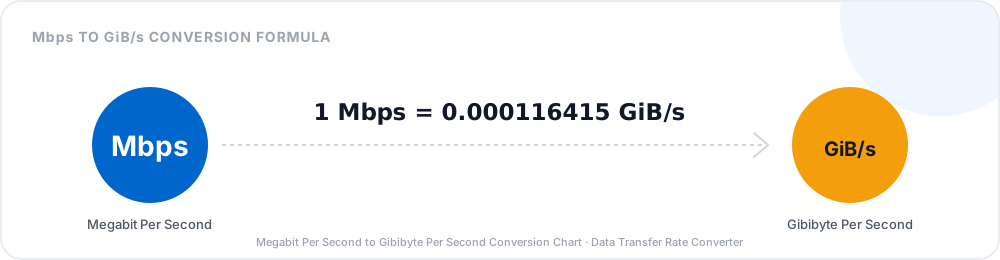
Megabit Per Second to Gibibyte Per Second Conversion Examples
10 Mbps = 0.001164153218 GiB/s
50 Mbps = 0.005820766091 GiB/s
100 Mbps = 0.011641532183 GiB/s
500 Mbps = 0.058207660913 GiB/s
1,000 Mbps = 0.116415321827 GiB/s
Most data transfer rate units step by powers of ten: moving up the scale (bps → Kbps → Mbps → Gbps and beyond) means multiply by 1000, moving down means divide by 1000 — usually just a matter of shifting the decimal point. What's actually being counted underneath is bits: the binary digits, 0s and 1s, that make up every network signal.
What Is Megabit Per Second (Mbps)? Definition and Uses
A megabit per second is 1,000,000 bits per second. The standard unit for home internet speeds.
The megabit per second is a bit-based bandwidth unit measuring data transfer speed, network bandwidth, or throughput capacity. Like the units used to measure file size, it's one of several data measurement units that scale using either decimal multiples of 1,000 (SI) or binary steps of 1,024 (IEC).
Common uses: Home internet speeds, WiFi connections, streaming video quality
1 Mbps = 1 × 10⁶ bits per second .
The megabit per second can be abbreviated as Mbps; for example, 1 megabit per second can be written as 1 Mbps.
Don't confuse Mbps with MB/s (Megabyte Per Second) — capitalization matters here. Mbps measures bits, MB/s measures bytes, and since 1 byte = 8 bits, 1 Mbps works out to just 0.125 MB/s using the same numeral.
Megabit Per Second Transfer Rate Unit at a Glance
| Unit type | bit-based bandwidth |
|---|---|
| Symbol | Mbps |
| Common uses | Home internet speeds, WiFi connections, streaming video quality |
What Is Gibibyte Per Second (GiB/s)? Definition and Uses
A gibibyte per second is 1,024 mebibytes per second. Binary equivalent of GB/s.
The gibibyte per second is a binary byte-based unit measuring data transfer speed, network bandwidth, or throughput capacity. Like the units used to measure file size, it's one of several data measurement units that scale using either decimal multiples of 1,000 (SI) or binary steps of 1,024 (IEC).
Common uses: Enterprise storage benchmarks, SAN performance, memory bandwidth
1 GiB/s = 9 × 10⁹ bits per second .
The gibibyte per second can be abbreviated as GiB/s; for example, 1 gibibyte per second can be written as 1 GiB/s.
Gibibyte Per Second Transfer Rate Unit at a Glance
| Unit type | binary byte-based |
|---|---|
| Symbol | GiB/s |
| Common uses | Enterprise storage benchmarks, SAN performance, memory bandwidth |
Megabit Per Second to Gibibyte Per Second Conversion Table
The table below shows 100 megabit per second measurements converted to gibibytes per second — scroll within the table to see the full range. Bookmark this reference table for quick lookups whenever you need to convert a value without shifting the decimal point by hand.
| Megabits Per Second | Gibibytes Per Second |
|---|---|
| 1 Mbps | 0.0001164153 GiB/s |
| 13 Mbps | 0.0015133992 GiB/s |
| 26 Mbps | 0.0030267984 GiB/s |
| 39 Mbps | 0.0045401976 GiB/s |
| 52 Mbps | 0.0060535967 GiB/s |
| 65 Mbps | 0.0075669959 GiB/s |
| 78 Mbps | 0.0090803951 GiB/s |
| 91 Mbps | 0.0105937943 GiB/s |
| 104 Mbps | 0.0121071935 GiB/s |
| 117 Mbps | 0.0136205927 GiB/s |
| 130 Mbps | 0.0151339918 GiB/s |
| 143 Mbps | 0.016647391 GiB/s |
| 156 Mbps | 0.0181607902 GiB/s |
| 169 Mbps | 0.0196741894 GiB/s |
| 182 Mbps | 0.0211875886 GiB/s |
| 195 Mbps | 0.0227009878 GiB/s |
| 208 Mbps | 0.0242143869 GiB/s |
| 221 Mbps | 0.0257277861 GiB/s |
| 234 Mbps | 0.0272411853 GiB/s |
| 247 Mbps | 0.0287545845 GiB/s |
| 260 Mbps | 0.0302679837 GiB/s |
| 273 Mbps | 0.0317813829 GiB/s |
| 286 Mbps | 0.033294782 GiB/s |
| 299 Mbps | 0.0348081812 GiB/s |
| 312 Mbps | 0.0363215804 GiB/s |
| 325 Mbps | 0.0378349796 GiB/s |
| 338 Mbps | 0.0393483788 GiB/s |
| 351 Mbps | 0.040861778 GiB/s |
| 364 Mbps | 0.0423751771 GiB/s |
| 377 Mbps | 0.0438885763 GiB/s |
| 390 Mbps | 0.0454019755 GiB/s |
| 403 Mbps | 0.0469153747 GiB/s |
| 416 Mbps | 0.0484287739 GiB/s |
| 429 Mbps | 0.0499421731 GiB/s |
| 442 Mbps | 0.0514555722 GiB/s |
| 455 Mbps | 0.0529689714 GiB/s |
| 468 Mbps | 0.0544823706 GiB/s |
| 481 Mbps | 0.0559957698 GiB/s |
| 494 Mbps | 0.057509169 GiB/s |
| 507 Mbps | 0.0590225682 GiB/s |
| 520 Mbps | 0.0605359674 GiB/s |
| 533 Mbps | 0.0620493665 GiB/s |
| 546 Mbps | 0.0635627657 GiB/s |
| 559 Mbps | 0.0650761649 GiB/s |
| 572 Mbps | 0.0665895641 GiB/s |
| 585 Mbps | 0.0681029633 GiB/s |
| 598 Mbps | 0.0696163625 GiB/s |
| 611 Mbps | 0.0711297616 GiB/s |
| 624 Mbps | 0.0726431608 GiB/s |
| 637 Mbps | 0.07415656 GiB/s |
| 650 Mbps | 0.0756699592 GiB/s |
| 663 Mbps | 0.0771833584 GiB/s |
| 676 Mbps | 0.0786967576 GiB/s |
| 689 Mbps | 0.0802101567 GiB/s |
| 702 Mbps | 0.0817235559 GiB/s |
| 715 Mbps | 0.0832369551 GiB/s |
| 728 Mbps | 0.0847503543 GiB/s |
| 741 Mbps | 0.0862637535 GiB/s |
| 754 Mbps | 0.0877771527 GiB/s |
| 767 Mbps | 0.0892905518 GiB/s |
| 780 Mbps | 0.090803951 GiB/s |
| 793 Mbps | 0.0923173502 GiB/s |
| 806 Mbps | 0.0938307494 GiB/s |
| 819 Mbps | 0.0953441486 GiB/s |
| 832 Mbps | 0.0968575478 GiB/s |
| 845 Mbps | 0.0983709469 GiB/s |
| 858 Mbps | 0.0998843461 GiB/s |
| 871 Mbps | 0.1013977453 GiB/s |
| 884 Mbps | 0.1029111445 GiB/s |
| 897 Mbps | 0.1044245437 GiB/s |
| 910 Mbps | 0.1059379429 GiB/s |
| 923 Mbps | 0.107451342 GiB/s |
| 936 Mbps | 0.1089647412 GiB/s |
| 949 Mbps | 0.1104781404 GiB/s |
| 962 Mbps | 0.1119915396 GiB/s |
| 975 Mbps | 0.1135049388 GiB/s |
| 988 Mbps | 0.115018338 GiB/s |
| 1,001 Mbps | 0.1165317371 GiB/s |
| 1,014 Mbps | 0.1180451363 GiB/s |
| 1,027 Mbps | 0.1195585355 GiB/s |
| 1,040 Mbps | 0.1210719347 GiB/s |
| 1,053 Mbps | 0.1225853339 GiB/s |
| 1,066 Mbps | 0.1240987331 GiB/s |
| 1,079 Mbps | 0.1256121323 GiB/s |
| 1,092 Mbps | 0.1271255314 GiB/s |
| 1,105 Mbps | 0.1286389306 GiB/s |
| 1,118 Mbps | 0.1301523298 GiB/s |
| 1,131 Mbps | 0.131665729 GiB/s |
| 1,144 Mbps | 0.1331791282 GiB/s |
| 1,157 Mbps | 0.1346925274 GiB/s |
| 1,170 Mbps | 0.1362059265 GiB/s |
| 1,183 Mbps | 0.1377193257 GiB/s |
| 1,196 Mbps | 0.1392327249 GiB/s |
| 1,209 Mbps | 0.1407461241 GiB/s |
| 1,222 Mbps | 0.1422595233 GiB/s |
| 1,235 Mbps | 0.1437729225 GiB/s |
| 1,248 Mbps | 0.1452863216 GiB/s |
| 1,261 Mbps | 0.1467997208 GiB/s |
| 1,274 Mbps | 0.14831312 GiB/s |
| 1,287 Mbps | 0.1498265192 GiB/s |
SI Decimal vs Binary: Why Mbps to GiB/s Is Not a Round Number
Megabit Per Second (Mbps) is an SI decimal unit: each prefix step multiplies by 1,000, so 1 Mbps = 1,000,000 bps. Gibibyte Per Second (GiB/s) is an IEC binary unit: each prefix step multiplies by 1,024, so 1 GiB/s = 8,589,934,592 bps. Dividing one by the other gives 0.000116415322, which is why Mbps to GiB/s is not a round number. Because one unit counts bits and the other bytes, the factor also includes a factor of 8.
| Unit | Standard | Prefix step | 1 unit equals |
|---|---|---|---|
| Megabit Per Second (Mbps) | SI decimal | 1,000 | 1,000,000 bps |
| Gibibyte Per Second (GiB/s) | Binary (IEC) | 1,024 | 8,589,934,592 bps |
To compare like with like, use Mbps to GB/s for SI decimal or Mibps to GiB/s for binary (IEC).
FAQs: Megabit Per Second to Gibibyte Per Second Conversion
6 questions Quick answers on converting megabits per second to gibibytes per second, using the same factors as the converter above.
-
How many gibibytes per second are in 1 megabit per second?
1 Mbps = 0.000116415322 GiB/s
1 Megabit Per Second (Mbps) equals 0.000116415322 Gibibytes Per Second.
-
How many megabits per second are in 1 gibibyte per second?
1 GiB/s = 8,589.934592 Mbps
1 Gibibyte Per Second (GiB/s) equals 8,589.934592 Megabits Per Second.
-
How do I convert megabits per second to gibibytes per second?
Mbps × 0.000116415322 = GiB/s
Multiply the megabit per second value by 0.000116415322 to get gibibytes per second. For example, 10 Mbps = 0.001164153218 GiB/s. To convert back (vice versa), multiply gibibytes per second by 8,589.934592.
-
What is the difference between megabits per second and gibibytes per second?
Mbps measures network bandwidth in bits per second, while GiB/s measures actual transfer throughput in bytes per second. Divide bits by 8 to get bytes.
-
Why is Mbps to GiB/s not a round number?
1 Mbps = 1,000,000 bps · 1 GiB/s = 8,589,934,592 bps
Megabit Per Second (Mbps) is an SI decimal (base 10) unit and Gibibyte Per Second (GiB/s) is a binary IEC (base 2) unit, so their prefixes step by 1,000 and 1,024. That is why 1 Mbps = 0.000116415322 GiB/s instead of a round number. Because one unit counts bits and the other bytes, the factor also includes a factor of 8.
-
What is Megabit Per Second (Mbps) commonly used for?
Common uses of the megabit per second (Mbps) include: Home internet speeds, WiFi connections, streaming video quality.
Need another value? Use the Mbps to GiB/s converter or convert GiB/s to Mbps.