

1 Zbps = 111,022.302463 PiB/s
Zettabits Per Second to Pebibytes Per Second Converter: Zbps to PiB/s Conversion Calculator
To convert zettabits per second to pebibytes per second (Zbps to PiB/s), enter your zettabit per second value in the From box and click the Convert button. Your pebibyte per second result also appears in the To box as you type, mixing SI decimal and binary (IEC) prefixes and converting between bits and bytes. This free Zbps to PiB/s converter and conversion calculator also works vice versa: type in the To box to convert PiB/s back to Zbps, use Swap units to flip the pair, or Reset to start over.
Zettabit Per Second (Zbps)
A zettabit per second is 1,000 exabits per second. Theoretical unit for measuring future global network capacity.
View the zettabit per second data unit pagePebibyte Per Second (PiB/s)
A pebibyte per second is 1,024 tebibytes per second. Binary equivalent of PB/s.
View the pebibyte per second data unit pageHow to Convert Zettabits Per Second to Pebibytes Per Second
To convert zettabits per second to pebibytes per second, divide by 0.000009007199255 (or multiply by 111,022.302463). This conversion accounts for the 8:1 relationship between bits and bytes—network speeds are measured in bits, while file sizes use bytes.
Zbps is a bit-based bandwidth commonly used for Theoretical global internet projections, future network capacity estimates, academic research. When you see your ISP advertise speeds in Zbps, this is the raw network bandwidth.
PiB/s is what you actually experience when downloading files. Your browser, torrent client, or download manager shows speeds in PiB/s because that's how fast data is being written to your storage.
1 Zbps = 111,022.302463 PiB/s — which means there are 111,022.302463pebibytes per second in every zettabit per second.
Zbps to PiB/s transfer rate: 1 zettabit per second equals 111,022.302463pebibytes per second — the standard bandwidth conversion rate used by this data transfer calculator.
Quick Facts: Zbps to PiB/s Speed Conversion
- Conversion factor: 1 Zbps = 111,022.302463 PiB/s
- Reverse factor: 1 PiB/s = 0.000009007199255 Zbps
- Source unit type: bit-based bandwidth
- Target unit type: binary byte-based
- Useful for: estimating download times, comparing advertised speeds, and network capacity planning
- Category: data transfer rate converter, network speed calculator, bandwidth converter
Steps to Convert Zettabit Per Second to Pebibyte Per Second
- Enter your zettabit per second value (Zbps) into the zettabit per second to pebibyte per second converter above.
- The equivalent pebibytes per second (PiB/s) transfer speed appears instantly in the To box using the Zbps to PiB/s conversion factor; click the Convert button to recalculate and highlight the result.
- To convert pebibytes per second back into zettabits per second, type in the To box instead, or use the swap control to flip the pair.
Zbps to PiB/s Conversion Formula
Here's the exact Zbps to PiB/s formula in copy-paste-ready form — multiply by 111,022.302463 to go from zettabits per second to pebibytes per second, or by 0.000009007199255 to reverse it — followed by a quick-reference chart of the same rate conversion.
// Convert Zbps to PiB/s
PiB/s = Zbps × 111,022.302463

// Reverse: Convert PiB/s to Zbps
Zbps = PiB/s × 0.000009007199255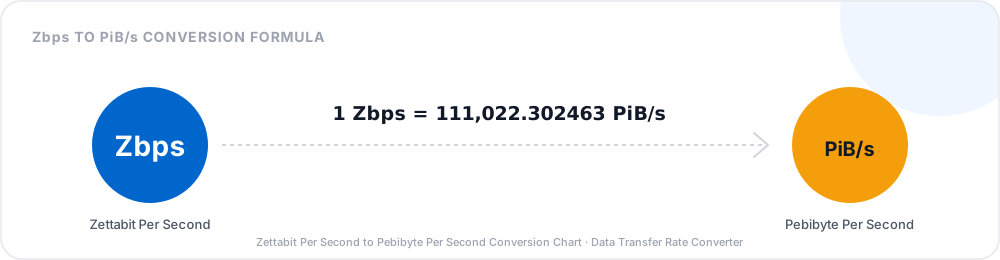
Zettabit Per Second to Pebibyte Per Second Conversion Examples
10 Zbps = 1,110,223 PiB/s
50 Zbps = 5,551,115 PiB/s
100 Zbps = 11,102,230 PiB/s
500 Zbps = 55,511,151 PiB/s
1,000 Zbps = 111,022,302 PiB/s
Most data transfer rate units step by powers of ten: moving up the scale (bps → Kbps → Mbps → Gbps and beyond) means multiply by 1000, moving down means divide by 1000 — usually just a matter of shifting the decimal point. What's actually being counted underneath is bits: the binary digits, 0s and 1s, that make up every network signal.
What Is Zettabit Per Second (Zbps)? Definition and Uses
A zettabit per second is 1,000 exabits per second. Theoretical unit for measuring future global network capacity.
The zettabit per second is a bit-based bandwidth unit measuring data transfer speed, network bandwidth, or throughput capacity. Like the units used to measure file size, it's one of several data measurement units that scale using either decimal multiples of 1,000 (SI) or binary steps of 1,024 (IEC).
Common uses: Theoretical global internet projections, future network capacity estimates, academic research
1 Zbps = 1 × 10²¹ bits per second .
The zettabit per second can be abbreviated as Zbps; for example, 1 zettabit per second can be written as 1 Zbps.
Don't confuse Zbps with ZB/s (Zettabyte Per Second) — capitalization matters here. Zbps measures bits, ZB/s measures bytes, and since 1 byte = 8 bits, 1 Zbps works out to just 0.125 ZB/s using the same numeral.
Zettabit Per Second Transfer Rate Unit at a Glance
| Unit type | bit-based bandwidth |
|---|---|
| Symbol | Zbps |
| Common uses | Theoretical global internet projections, future network capacity estimates, academic research |
What Is Pebibyte Per Second (PiB/s)? Definition and Uses
A pebibyte per second is 1,024 tebibytes per second. Binary equivalent of PB/s.
The pebibyte per second is a binary byte-based unit measuring data transfer speed, network bandwidth, or throughput capacity. Like the units used to measure file size, it's one of several data measurement units that scale using either decimal multiples of 1,000 (SI) or binary steps of 1,024 (IEC).
Common uses: Supercomputer binary benchmarks, hyperscale storage systems, exascale computing
1 PiB/s = 9 × 10¹⁵ bits per second .
The pebibyte per second can be abbreviated as PiB/s; for example, 1 pebibyte per second can be written as 1 PiB/s.
Pebibyte Per Second Transfer Rate Unit at a Glance
| Unit type | binary byte-based |
|---|---|
| Symbol | PiB/s |
| Common uses | Supercomputer binary benchmarks, hyperscale storage systems, exascale computing |
Zettabit Per Second to Pebibyte Per Second Conversion Table
The table below shows 100 zettabit per second measurements converted to pebibytes per second — scroll within the table to see the full range. Bookmark this reference table for quick lookups whenever you need to convert a value without shifting the decimal point by hand.
| Zettabits Per Second | Pebibytes Per Second |
|---|---|
| 1 Zbps | 111,022.30246252 PiB/s |
| 13 Zbps | 1,443,290 PiB/s |
| 26 Zbps | 2,886,580 PiB/s |
| 39 Zbps | 4,329,870 PiB/s |
| 52 Zbps | 5,773,160 PiB/s |
| 65 Zbps | 7,216,450 PiB/s |
| 78 Zbps | 8,659,740 PiB/s |
| 91 Zbps | 10,103,030 PiB/s |
| 104 Zbps | 11,546,319 PiB/s |
| 117 Zbps | 12,989,609 PiB/s |
| 130 Zbps | 14,432,899 PiB/s |
| 143 Zbps | 15,876,189 PiB/s |
| 156 Zbps | 17,319,479 PiB/s |
| 169 Zbps | 18,762,769 PiB/s |
| 182 Zbps | 20,206,059 PiB/s |
| 195 Zbps | 21,649,349 PiB/s |
| 208 Zbps | 23,092,639 PiB/s |
| 221 Zbps | 24,535,929 PiB/s |
| 234 Zbps | 25,979,219 PiB/s |
| 247 Zbps | 27,422,509 PiB/s |
| 260 Zbps | 28,865,799 PiB/s |
| 273 Zbps | 30,309,089 PiB/s |
| 286 Zbps | 31,752,379 PiB/s |
| 299 Zbps | 33,195,668 PiB/s |
| 312 Zbps | 34,638,958 PiB/s |
| 325 Zbps | 36,082,248 PiB/s |
| 338 Zbps | 37,525,538 PiB/s |
| 351 Zbps | 38,968,828 PiB/s |
| 364 Zbps | 40,412,118 PiB/s |
| 377 Zbps | 41,855,408 PiB/s |
| 390 Zbps | 43,298,698 PiB/s |
| 403 Zbps | 44,741,988 PiB/s |
| 416 Zbps | 46,185,278 PiB/s |
| 429 Zbps | 47,628,568 PiB/s |
| 442 Zbps | 49,071,858 PiB/s |
| 455 Zbps | 50,515,148 PiB/s |
| 468 Zbps | 51,958,438 PiB/s |
| 481 Zbps | 53,401,727 PiB/s |
| 494 Zbps | 54,845,017 PiB/s |
| 507 Zbps | 56,288,307 PiB/s |
| 520 Zbps | 57,731,597 PiB/s |
| 533 Zbps | 59,174,887 PiB/s |
| 546 Zbps | 60,618,177 PiB/s |
| 559 Zbps | 62,061,467 PiB/s |
| 572 Zbps | 63,504,757 PiB/s |
| 585 Zbps | 64,948,047 PiB/s |
| 598 Zbps | 66,391,337 PiB/s |
| 611 Zbps | 67,834,627 PiB/s |
| 624 Zbps | 69,277,917 PiB/s |
| 637 Zbps | 70,721,207 PiB/s |
| 650 Zbps | 72,164,497 PiB/s |
| 663 Zbps | 73,607,787 PiB/s |
| 676 Zbps | 75,051,076 PiB/s |
| 689 Zbps | 76,494,366 PiB/s |
| 702 Zbps | 77,937,656 PiB/s |
| 715 Zbps | 79,380,946 PiB/s |
| 728 Zbps | 80,824,236 PiB/s |
| 741 Zbps | 82,267,526 PiB/s |
| 754 Zbps | 83,710,816 PiB/s |
| 767 Zbps | 85,154,106 PiB/s |
| 780 Zbps | 86,597,396 PiB/s |
| 793 Zbps | 88,040,686 PiB/s |
| 806 Zbps | 89,483,976 PiB/s |
| 819 Zbps | 90,927,266 PiB/s |
| 832 Zbps | 92,370,556 PiB/s |
| 845 Zbps | 93,813,846 PiB/s |
| 858 Zbps | 95,257,136 PiB/s |
| 871 Zbps | 96,700,425 PiB/s |
| 884 Zbps | 98,143,715 PiB/s |
| 897 Zbps | 99,587,005 PiB/s |
| 910 Zbps | 101,030,295 PiB/s |
| 923 Zbps | 102,473,585 PiB/s |
| 936 Zbps | 103,916,875 PiB/s |
| 949 Zbps | 105,360,165 PiB/s |
| 962 Zbps | 106,803,455 PiB/s |
| 975 Zbps | 108,246,745 PiB/s |
| 988 Zbps | 109,690,035 PiB/s |
| 1,001 Zbps | 111,133,325 PiB/s |
| 1,014 Zbps | 112,576,615 PiB/s |
| 1,027 Zbps | 114,019,905 PiB/s |
| 1,040 Zbps | 115,463,195 PiB/s |
| 1,053 Zbps | 116,906,484 PiB/s |
| 1,066 Zbps | 118,349,774 PiB/s |
| 1,079 Zbps | 119,793,064 PiB/s |
| 1,092 Zbps | 121,236,354 PiB/s |
| 1,105 Zbps | 122,679,644 PiB/s |
| 1,118 Zbps | 124,122,934 PiB/s |
| 1,131 Zbps | 125,566,224 PiB/s |
| 1,144 Zbps | 127,009,514 PiB/s |
| 1,157 Zbps | 128,452,804 PiB/s |
| 1,170 Zbps | 129,896,094 PiB/s |
| 1,183 Zbps | 131,339,384 PiB/s |
| 1,196 Zbps | 132,782,674 PiB/s |
| 1,209 Zbps | 134,225,964 PiB/s |
| 1,222 Zbps | 135,669,254 PiB/s |
| 1,235 Zbps | 137,112,544 PiB/s |
| 1,248 Zbps | 138,555,833 PiB/s |
| 1,261 Zbps | 139,999,123 PiB/s |
| 1,274 Zbps | 141,442,413 PiB/s |
| 1,287 Zbps | 142,885,703 PiB/s |
SI Decimal vs Binary: Why Zbps to PiB/s Is Not a Round Number
Zettabit Per Second (Zbps) is an SI decimal unit: each prefix step multiplies by 1,000, so 1 Zbps = 1.000 × 10²¹ bps. Pebibyte Per Second (PiB/s) is an IEC binary unit: each prefix step multiplies by 1,024, so 1 PiB/s = 9.007 × 10¹⁵ bps. Dividing one by the other gives 111,022.302463, which is why Zbps to PiB/s is not a round number. Because one unit counts bits and the other bytes, the factor also includes a factor of 8.
| Unit | Standard | Prefix step | 1 unit equals |
|---|---|---|---|
| Zettabit Per Second (Zbps) | SI decimal | 1,000 | 1.000 × 10²¹ bps |
| Pebibyte Per Second (PiB/s) | Binary (IEC) | 1,024 | 9.007 × 10¹⁵ bps |
To compare like with like, use Zbps to PB/s for SI decimal or Zibps to PiB/s for binary (IEC).
FAQs: Zettabit Per Second to Pebibyte Per Second Conversion
6 questions Quick answers on converting zettabits per second to pebibytes per second, using the same factors as the converter above.
-
How many pebibytes per second are in 1 zettabit per second?
1 Zbps = 111,022.302463 PiB/s
1 Zettabit Per Second (Zbps) equals 111,022.302463 Pebibytes Per Second.
-
How many zettabits per second are in 1 pebibyte per second?
1 PiB/s = 0.000009007199255 Zbps
1 Pebibyte Per Second (PiB/s) equals 0.000009007199255 Zettabits Per Second.
-
How do I convert zettabits per second to pebibytes per second?
Zbps × 111,022.302463 = PiB/s
Multiply the zettabit per second value by 111,022.302463 to get pebibytes per second. For example, 10 Zbps = 1,110,223 PiB/s. To convert back (vice versa), multiply pebibytes per second by 0.000009007199255.
-
What is the difference between zettabits per second and pebibytes per second?
Zbps measures network bandwidth in bits per second, while PiB/s measures actual transfer throughput in bytes per second. Divide bits by 8 to get bytes.
-
Why is Zbps to PiB/s not a round number?
1 Zbps = 1.000 × 10²¹ bps · 1 PiB/s = 9.007 × 10¹⁵ bps
Zettabit Per Second (Zbps) is an SI decimal (base 10) unit and Pebibyte Per Second (PiB/s) is a binary IEC (base 2) unit, so their prefixes step by 1,000 and 1,024. That is why 1 Zbps = 111,022.302463 PiB/s instead of a round number. Because one unit counts bits and the other bytes, the factor also includes a factor of 8.
-
What is Zettabit Per Second (Zbps) commonly used for?
Common uses of the zettabit per second (Zbps) include: Theoretical global internet projections, future network capacity estimates, academic research.
Need another value? Use the Zbps to PiB/s converter or convert PiB/s to Zbps.