

1 Zibps = 0.001180591621 Ybps
Zebibits Per Second to Yottabits Per Second Converter: Zibps to Ybps Conversion Calculator
To convert zebibits per second to yottabits per second (Zibps to Ybps), enter your zebibit per second value in the From box and click the Convert button. Your yottabit per second result also appears in the To box as you type, mixing SI decimal and binary (IEC) prefixes. This free Zibps to Ybps converter and conversion calculator also works vice versa: type in the To box to convert Ybps back to Zibps, use Swap units to flip the pair, or Reset to start over.
Zebibit Per Second (Zibps)
A zebibit per second is 1,024 exbibits per second. Binary equivalent of Zbps.
View the zebibit per second data unit pageYottabit Per Second (Ybps)
A yottabit per second is 1,000 zettabits per second. The largest SI unit for data transfer rates.
View the yottabit per second data unit pageHow to Convert Zebibits Per Second to Yottabits Per Second
To convert zebibits per second to yottabits per second, divide by 847.0329472543. Both units measure network bandwidth in bits per second—the difference is simply the scale.
Zibps: A zebibit per second is 1,024 exbibits per second. Binary equivalent of Zbps. Common uses include Theoretical binary bandwidth limits, future network projections, academic research.
Ybps: A yottabit per second is 1,000 zettabits per second. The largest SI unit for data transfer rates. Typically used for Theoretical capacity limits, far-future projections, academic discussions.
1 Zibps = 0.001180591621 Ybps — or equivalently, 1 Ybps = 847.0329472543Zibps.
Zibps to Ybps transfer rate: 1 zebibit per second equals 0.001180591621yottabits per second — the standard bandwidth conversion rate used by this data transfer calculator.
Quick Facts: Zibps to Ybps Speed Conversion
- Conversion factor: 1 Zibps = 0.001180591621 Ybps
- Reverse factor: 1 Ybps = 847.0329472543 Zibps
- Source unit type: binary bit-based
- Target unit type: bit-based bandwidth
- Useful for: estimating download times, comparing advertised speeds, and network capacity planning
- Category: data transfer rate converter, network speed calculator, bandwidth converter
Steps to Convert Zebibit Per Second to Yottabit Per Second
- Enter your zebibit per second value (Zibps) into the zebibit per second to yottabit per second converter above.
- The equivalent yottabits per second (Ybps) transfer speed appears instantly in the To box using the Zibps to Ybps conversion factor; click the Convert button to recalculate and highlight the result.
- To convert yottabits per second back into zebibits per second, type in the To box instead, or use the swap control to flip the pair.
Zibps to Ybps Conversion Formula
Here's the exact Zibps to Ybps formula in copy-paste-ready form — multiply by 0.001180591621 to go from zebibits per second to yottabits per second, or by 847.0329472543 to reverse it — followed by a quick-reference chart of the same rate conversion.
// Convert Zibps to Ybps
Ybps = Zibps × 0.001180591621

// Reverse: Convert Ybps to Zibps
Zibps = Ybps × 847.0329472543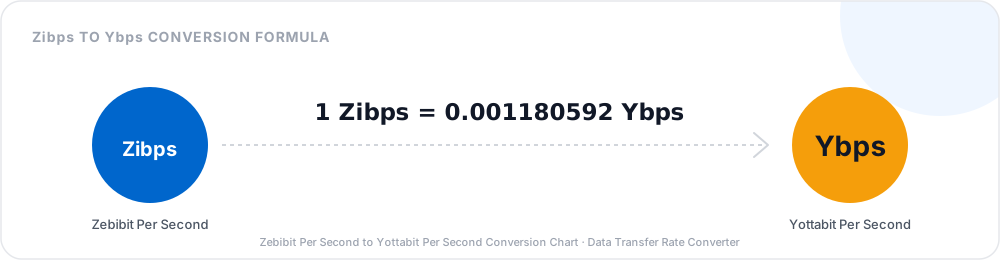
Zebibit Per Second to Yottabit Per Second Conversion Examples
10 Zibps = 0.011805916207 Ybps
50 Zibps = 0.059029581036 Ybps
100 Zibps = 0.118059162072 Ybps
500 Zibps = 0.590295810359 Ybps
1,000 Zibps = 1.1805916207 Ybps
Most data transfer rate units step by powers of ten: moving up the scale (bps → Kbps → Mbps → Gbps and beyond) means multiply by 1000, moving down means divide by 1000 — usually just a matter of shifting the decimal point. What's actually being counted underneath is bits: the binary digits, 0s and 1s, that make up every network signal.
What Is Zebibit Per Second (Zibps)? Definition and Uses
A zebibit per second is 1,024 exbibits per second. Binary equivalent of Zbps.
The zebibit per second is a binary bit-based unit measuring data transfer speed, network bandwidth, or throughput capacity. Like the units used to measure file size, it's one of several data measurement units that scale using either decimal multiples of 1,000 (SI) or binary steps of 1,024 (IEC).
Common uses: Theoretical binary bandwidth limits, future network projections, academic research
1 Zibps = 1 × 10²¹ bits per second .
The zebibit per second can be abbreviated as Zibps; for example, 1 zebibit per second can be written as 1 Zibps.
Don't confuse Zibps with ZiB/s (Zebibyte Per Second) — capitalization matters here. Zibps measures bits, ZiB/s measures bytes, and since 1 byte = 8 bits, 1 Zibps works out to just 0.125 ZiB/s using the same numeral.
Zebibit Per Second Transfer Rate Unit at a Glance
| Unit type | binary bit-based |
|---|---|
| Symbol | Zibps |
| Common uses | Theoretical binary bandwidth limits, future network projections, academic research |
What Is Yottabit Per Second (Ybps)? Definition and Uses
A yottabit per second is 1,000 zettabits per second. The largest SI unit for data transfer rates.
The yottabit per second is a bit-based bandwidth unit measuring data transfer speed, network bandwidth, or throughput capacity. Like the units used to measure file size, it's one of several data measurement units that scale using either decimal multiples of 1,000 (SI) or binary steps of 1,024 (IEC).
Common uses: Theoretical capacity limits, far-future projections, academic discussions
1 Ybps = 1 × 10²⁴ bits per second .
The yottabit per second can be abbreviated as Ybps; for example, 1 yottabit per second can be written as 1 Ybps.
Don't confuse Ybps with YB/s (Yottabyte Per Second) — capitalization matters here. Ybps measures bits, YB/s measures bytes, and since 1 byte = 8 bits, 1 Ybps works out to just 0.125 YB/s using the same numeral.
Yottabit Per Second Transfer Rate Unit at a Glance
| Unit type | bit-based bandwidth |
|---|---|
| Symbol | Ybps |
| Common uses | Theoretical capacity limits, far-future projections, academic discussions |
Zebibit Per Second to Yottabit Per Second Conversion Table
The table below shows 100 zebibit per second measurements converted to yottabits per second — scroll within the table to see the full range. Bookmark this reference table for quick lookups whenever you need to convert a value without shifting the decimal point by hand.
| Zebibits Per Second | Yottabits Per Second |
|---|---|
| 1 Zibps | 0.0011805916 Ybps |
| 13 Zibps | 0.0153476911 Ybps |
| 26 Zibps | 0.0306953821 Ybps |
| 39 Zibps | 0.0460430732 Ybps |
| 52 Zibps | 0.0613907643 Ybps |
| 65 Zibps | 0.0767384553 Ybps |
| 78 Zibps | 0.0920861464 Ybps |
| 91 Zibps | 0.1074338375 Ybps |
| 104 Zibps | 0.1227815286 Ybps |
| 117 Zibps | 0.1381292196 Ybps |
| 130 Zibps | 0.1534769107 Ybps |
| 143 Zibps | 0.1688246018 Ybps |
| 156 Zibps | 0.1841722928 Ybps |
| 169 Zibps | 0.1995199839 Ybps |
| 182 Zibps | 0.214867675 Ybps |
| 195 Zibps | 0.230215366 Ybps |
| 208 Zibps | 0.2455630571 Ybps |
| 221 Zibps | 0.2609107482 Ybps |
| 234 Zibps | 0.2762584392 Ybps |
| 247 Zibps | 0.2916061303 Ybps |
| 260 Zibps | 0.3069538214 Ybps |
| 273 Zibps | 0.3223015125 Ybps |
| 286 Zibps | 0.3376492035 Ybps |
| 299 Zibps | 0.3529968946 Ybps |
| 312 Zibps | 0.3683445857 Ybps |
| 325 Zibps | 0.3836922767 Ybps |
| 338 Zibps | 0.3990399678 Ybps |
| 351 Zibps | 0.4143876589 Ybps |
| 364 Zibps | 0.4297353499 Ybps |
| 377 Zibps | 0.445083041 Ybps |
| 390 Zibps | 0.4604307321 Ybps |
| 403 Zibps | 0.4757784231 Ybps |
| 416 Zibps | 0.4911261142 Ybps |
| 429 Zibps | 0.5064738053 Ybps |
| 442 Zibps | 0.5218214964 Ybps |
| 455 Zibps | 0.5371691874 Ybps |
| 468 Zibps | 0.5525168785 Ybps |
| 481 Zibps | 0.5678645696 Ybps |
| 494 Zibps | 0.5832122606 Ybps |
| 507 Zibps | 0.5985599517 Ybps |
| 520 Zibps | 0.6139076428 Ybps |
| 533 Zibps | 0.6292553338 Ybps |
| 546 Zibps | 0.6446030249 Ybps |
| 559 Zibps | 0.659950716 Ybps |
| 572 Zibps | 0.6752984071 Ybps |
| 585 Zibps | 0.6906460981 Ybps |
| 598 Zibps | 0.7059937892 Ybps |
| 611 Zibps | 0.7213414803 Ybps |
| 624 Zibps | 0.7366891713 Ybps |
| 637 Zibps | 0.7520368624 Ybps |
| 650 Zibps | 0.7673845535 Ybps |
| 663 Zibps | 0.7827322445 Ybps |
| 676 Zibps | 0.7980799356 Ybps |
| 689 Zibps | 0.8134276267 Ybps |
| 702 Zibps | 0.8287753177 Ybps |
| 715 Zibps | 0.8441230088 Ybps |
| 728 Zibps | 0.8594706999 Ybps |
| 741 Zibps | 0.874818391 Ybps |
| 754 Zibps | 0.890166082 Ybps |
| 767 Zibps | 0.9055137731 Ybps |
| 780 Zibps | 0.9208614642 Ybps |
| 793 Zibps | 0.9362091552 Ybps |
| 806 Zibps | 0.9515568463 Ybps |
| 819 Zibps | 0.9669045374 Ybps |
| 832 Zibps | 0.9822522284 Ybps |
| 845 Zibps | 0.9975999195 Ybps |
| 858 Zibps | 1.01294761 Ybps |
| 871 Zibps | 1.0282953 Ybps |
| 884 Zibps | 1.04364299 Ybps |
| 897 Zibps | 1.05899068 Ybps |
| 910 Zibps | 1.07433837 Ybps |
| 923 Zibps | 1.08968607 Ybps |
| 936 Zibps | 1.10503376 Ybps |
| 949 Zibps | 1.12038145 Ybps |
| 962 Zibps | 1.13572914 Ybps |
| 975 Zibps | 1.15107683 Ybps |
| 988 Zibps | 1.16642452 Ybps |
| 1,001 Zibps | 1.18177221 Ybps |
| 1,014 Zibps | 1.1971199 Ybps |
| 1,027 Zibps | 1.21246759 Ybps |
| 1,040 Zibps | 1.22781529 Ybps |
| 1,053 Zibps | 1.24316298 Ybps |
| 1,066 Zibps | 1.25851067 Ybps |
| 1,079 Zibps | 1.27385836 Ybps |
| 1,092 Zibps | 1.28920605 Ybps |
| 1,105 Zibps | 1.30455374 Ybps |
| 1,118 Zibps | 1.31990143 Ybps |
| 1,131 Zibps | 1.33524912 Ybps |
| 1,144 Zibps | 1.35059681 Ybps |
| 1,157 Zibps | 1.36594451 Ybps |
| 1,170 Zibps | 1.3812922 Ybps |
| 1,183 Zibps | 1.39663989 Ybps |
| 1,196 Zibps | 1.41198758 Ybps |
| 1,209 Zibps | 1.42733527 Ybps |
| 1,222 Zibps | 1.44268296 Ybps |
| 1,235 Zibps | 1.45803065 Ybps |
| 1,248 Zibps | 1.47337834 Ybps |
| 1,261 Zibps | 1.48872603 Ybps |
| 1,274 Zibps | 1.50407372 Ybps |
| 1,287 Zibps | 1.51942142 Ybps |
SI Decimal vs Binary: Why Zibps to Ybps Is Not a Round Number
Yottabit Per Second (Ybps) is an SI decimal unit: each prefix step multiplies by 1,000, so 1 Ybps = 1.000 × 10²⁴ bps. Zebibit Per Second (Zibps) is an IEC binary unit: each prefix step multiplies by 1,024, so 1 Zibps = 1.181 × 10²¹ bps. Dividing one by the other gives 0.001180591621, which is why Zibps to Ybps is not a round number.
| Unit | Standard | Prefix step | 1 unit equals |
|---|---|---|---|
| Zebibit Per Second (Zibps) | Binary (IEC) | 1,024 | 1.181 × 10²¹ bps |
| Yottabit Per Second (Ybps) | SI decimal | 1,000 | 1.000 × 10²⁴ bps |
To compare like with like, use Zbps to Ybps for SI decimal or Zibps to Yibps for binary (IEC).
FAQs: Zebibit Per Second to Yottabit Per Second Conversion
6 questions Quick answers on converting zebibits per second to yottabits per second, using the same factors as the converter above.
-
How many yottabits per second are in 1 zebibit per second?
1 Zibps = 0.001180591621 Ybps
1 Zebibit Per Second (Zibps) equals 0.001180591621 Yottabits Per Second.
-
How many zebibits per second are in 1 yottabit per second?
1 Ybps = 847.0329472543 Zibps
1 Yottabit Per Second (Ybps) equals 847.0329472543 Zebibits Per Second.
-
How do I convert zebibits per second to yottabits per second?
Zibps × 0.001180591621 = Ybps
Multiply the zebibit per second value by 0.001180591621 to get yottabits per second. For example, 10 Zibps = 0.011805916207 Ybps. To convert back (vice versa), multiply yottabits per second by 847.0329472543.
-
Is zebibit per second bigger than yottabit per second?
Ybps is 847.0329472543× larger than Zibps
No. 1 Zibps = 0.001180591621 Ybps, so yottabit per second is larger — 1 Ybps = 847.0329472543 Zibps.
-
Why is Zibps to Ybps not a round number?
1 Ybps = 1.000 × 10²⁴ bps · 1 Zibps = 1.181 × 10²¹ bps
Yottabit Per Second (Ybps) is an SI decimal (base 10) unit and Zebibit Per Second (Zibps) is a binary IEC (base 2) unit, so their prefixes step by 1,000 and 1,024. That is why 1 Zibps = 0.001180591621 Ybps instead of a round number.
-
What is Zebibit Per Second (Zibps) commonly used for?
Common uses of the zebibit per second (Zibps) include: Theoretical binary bandwidth limits, future network projections, academic research.
Need another value? Use the Zibps to Ybps converter or convert Ybps to Zibps.