

1 Zibps = 0.14757395259 ZB/s
Zebibits Per Second to Zettabytes Per Second Converter: Zibps to ZB/s Conversion Calculator
To convert zebibits per second to zettabytes per second (Zibps to ZB/s), enter your zebibit per second value in the From box and click the Convert button. Your zettabyte per second result also appears in the To box as you type, mixing SI decimal and binary (IEC) prefixes and converting between bits and bytes. This free Zibps to ZB/s converter and conversion calculator also works vice versa: type in the To box to convert ZB/s back to Zibps, use Swap units to flip the pair, or Reset to start over.
Zebibit Per Second (Zibps)
A zebibit per second is 1,024 exbibits per second. Binary equivalent of Zbps.
View the zebibit per second data unit pageZettabyte Per Second (ZB/s)
A zettabyte per second is 1,000 exabytes per second. Theoretical unit for future computing capacity.
View the zettabyte per second data unit pageHow to Convert Zebibits Per Second to Zettabytes Per Second
To convert zebibits per second to zettabytes per second, divide by 6.776263578 (or multiply by 0.14757395259). This conversion accounts for the 8:1 relationship between bits and bytes—network speeds are measured in bits, while file sizes use bytes.
Zibps is a binary bit-based commonly used for Theoretical binary bandwidth limits, future network projections, academic research. When you see your ISP advertise speeds in Zibps, this is the raw network bandwidth.
ZB/s is what you actually experience when downloading files. Your browser, torrent client, or download manager shows speeds in ZB/s because that's how fast data is being written to your storage.
1 Zibps = 0.14757395259 ZB/s — or equivalently, 1 ZB/s = 6.776263578Zibps.
Zibps to ZB/s transfer rate: 1 zebibit per second equals 0.14757395259zettabytes per second — the standard bandwidth conversion rate used by this data transfer calculator.
Quick Facts: Zibps to ZB/s Speed Conversion
- Conversion factor: 1 Zibps = 0.14757395259 ZB/s
- Reverse factor: 1 ZB/s = 6.776263578 Zibps
- Source unit type: binary bit-based
- Target unit type: byte-based throughput
- Useful for: estimating download times, comparing advertised speeds, and network capacity planning
- Category: data transfer rate converter, network speed calculator, bandwidth converter
Steps to Convert Zebibit Per Second to Zettabyte Per Second
- Enter your zebibit per second value (Zibps) into the zebibit per second to zettabyte per second converter above.
- The equivalent zettabytes per second (ZB/s) transfer speed appears instantly in the To box using the Zibps to ZB/s conversion factor; click the Convert button to recalculate and highlight the result.
- To convert zettabytes per second back into zebibits per second, type in the To box instead, or use the swap control to flip the pair.
Zibps to ZB/s Conversion Formula
Here's the exact Zibps to ZB/s formula in copy-paste-ready form — multiply by 0.14757395259 to go from zebibits per second to zettabytes per second, or by 6.776263578 to reverse it — followed by a quick-reference chart of the same rate conversion.
// Convert Zibps to ZB/s
ZB/s = Zibps × 0.14757395259

// Reverse: Convert ZB/s to Zibps
Zibps = ZB/s × 6.776263578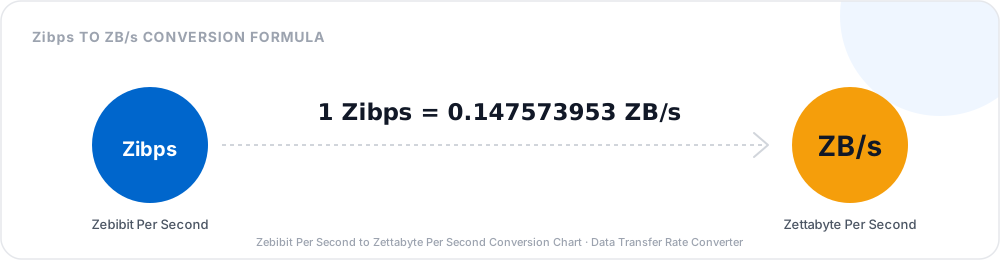
Zebibit Per Second to Zettabyte Per Second Conversion Examples
10 Zibps = 1.4757395259 ZB/s
50 Zibps = 7.3786976295 ZB/s
100 Zibps = 14.757395259 ZB/s
500 Zibps = 73.7869762948 ZB/s
1,000 Zibps = 147.5739525897 ZB/s
Most data transfer rate units step by powers of ten: moving up the scale (bps → Kbps → Mbps → Gbps and beyond) means multiply by 1000, moving down means divide by 1000 — usually just a matter of shifting the decimal point. What's actually being counted underneath is bits: the binary digits, 0s and 1s, that make up every network signal.
What Is Zebibit Per Second (Zibps)? Definition and Uses
A zebibit per second is 1,024 exbibits per second. Binary equivalent of Zbps.
The zebibit per second is a binary bit-based unit measuring data transfer speed, network bandwidth, or throughput capacity. Like the units used to measure file size, it's one of several data measurement units that scale using either decimal multiples of 1,000 (SI) or binary steps of 1,024 (IEC).
Common uses: Theoretical binary bandwidth limits, future network projections, academic research
1 Zibps = 1 × 10²¹ bits per second .
The zebibit per second can be abbreviated as Zibps; for example, 1 zebibit per second can be written as 1 Zibps.
Don't confuse Zibps with ZiB/s (Zebibyte Per Second) — capitalization matters here. Zibps measures bits, ZiB/s measures bytes, and since 1 byte = 8 bits, 1 Zibps works out to just 0.125 ZiB/s using the same numeral.
Zebibit Per Second Transfer Rate Unit at a Glance
| Unit type | binary bit-based |
|---|---|
| Symbol | Zibps |
| Common uses | Theoretical binary bandwidth limits, future network projections, academic research |
What Is Zettabyte Per Second (ZB/s)? Definition and Uses
A zettabyte per second is 1,000 exabytes per second. Theoretical unit for future computing capacity.
The zettabyte per second is a byte-based throughput unit measuring data transfer speed, network bandwidth, or throughput capacity. Like the units used to measure file size, it's one of several data measurement units that scale using either decimal multiples of 1,000 (SI) or binary steps of 1,024 (IEC).
Common uses: Theoretical capacity limits, future computing projections, academic research
1 ZB/s = 8 × 10²¹ bits per second .
The zettabyte per second can be abbreviated as ZB/s; for example, 1 zettabyte per second can be written as 1 ZB/s.
Zettabyte Per Second Transfer Rate Unit at a Glance
| Unit type | byte-based throughput |
|---|---|
| Symbol | ZB/s |
| Common uses | Theoretical capacity limits, future computing projections, academic research |
Zebibit Per Second to Zettabyte Per Second Conversion Table
The table below shows 100 zebibit per second measurements converted to zettabytes per second — scroll within the table to see the full range. Bookmark this reference table for quick lookups whenever you need to convert a value without shifting the decimal point by hand.
| Zebibits Per Second | Zettabytes Per Second |
|---|---|
| 1 Zibps | 0.1475739526 ZB/s |
| 13 Zibps | 1.91846138 ZB/s |
| 26 Zibps | 3.83692277 ZB/s |
| 39 Zibps | 5.75538415 ZB/s |
| 52 Zibps | 7.67384553 ZB/s |
| 65 Zibps | 9.59230692 ZB/s |
| 78 Zibps | 11.5107683 ZB/s |
| 91 Zibps | 13.42922969 ZB/s |
| 104 Zibps | 15.34769107 ZB/s |
| 117 Zibps | 17.26615245 ZB/s |
| 130 Zibps | 19.18461384 ZB/s |
| 143 Zibps | 21.10307522 ZB/s |
| 156 Zibps | 23.0215366 ZB/s |
| 169 Zibps | 24.93999799 ZB/s |
| 182 Zibps | 26.85845937 ZB/s |
| 195 Zibps | 28.77692075 ZB/s |
| 208 Zibps | 30.69538214 ZB/s |
| 221 Zibps | 32.61384352 ZB/s |
| 234 Zibps | 34.53230491 ZB/s |
| 247 Zibps | 36.45076629 ZB/s |
| 260 Zibps | 38.36922767 ZB/s |
| 273 Zibps | 40.28768906 ZB/s |
| 286 Zibps | 42.20615044 ZB/s |
| 299 Zibps | 44.12461182 ZB/s |
| 312 Zibps | 46.04307321 ZB/s |
| 325 Zibps | 47.96153459 ZB/s |
| 338 Zibps | 49.87999598 ZB/s |
| 351 Zibps | 51.79845736 ZB/s |
| 364 Zibps | 53.71691874 ZB/s |
| 377 Zibps | 55.63538013 ZB/s |
| 390 Zibps | 57.55384151 ZB/s |
| 403 Zibps | 59.47230289 ZB/s |
| 416 Zibps | 61.39076428 ZB/s |
| 429 Zibps | 63.30922566 ZB/s |
| 442 Zibps | 65.22768704 ZB/s |
| 455 Zibps | 67.14614843 ZB/s |
| 468 Zibps | 69.06460981 ZB/s |
| 481 Zibps | 70.9830712 ZB/s |
| 494 Zibps | 72.90153258 ZB/s |
| 507 Zibps | 74.81999396 ZB/s |
| 520 Zibps | 76.73845535 ZB/s |
| 533 Zibps | 78.65691673 ZB/s |
| 546 Zibps | 80.57537811 ZB/s |
| 559 Zibps | 82.4938395 ZB/s |
| 572 Zibps | 84.41230088 ZB/s |
| 585 Zibps | 86.33076226 ZB/s |
| 598 Zibps | 88.24922365 ZB/s |
| 611 Zibps | 90.16768503 ZB/s |
| 624 Zibps | 92.08614642 ZB/s |
| 637 Zibps | 94.0046078 ZB/s |
| 650 Zibps | 95.92306918 ZB/s |
| 663 Zibps | 97.84153057 ZB/s |
| 676 Zibps | 99.75999195 ZB/s |
| 689 Zibps | 101.67845333 ZB/s |
| 702 Zibps | 103.59691472 ZB/s |
| 715 Zibps | 105.5153761 ZB/s |
| 728 Zibps | 107.43383749 ZB/s |
| 741 Zibps | 109.35229887 ZB/s |
| 754 Zibps | 111.27076025 ZB/s |
| 767 Zibps | 113.18922164 ZB/s |
| 780 Zibps | 115.10768302 ZB/s |
| 793 Zibps | 117.0261444 ZB/s |
| 806 Zibps | 118.94460579 ZB/s |
| 819 Zibps | 120.86306717 ZB/s |
| 832 Zibps | 122.78152855 ZB/s |
| 845 Zibps | 124.69998994 ZB/s |
| 858 Zibps | 126.61845132 ZB/s |
| 871 Zibps | 128.53691271 ZB/s |
| 884 Zibps | 130.45537409 ZB/s |
| 897 Zibps | 132.37383547 ZB/s |
| 910 Zibps | 134.29229686 ZB/s |
| 923 Zibps | 136.21075824 ZB/s |
| 936 Zibps | 138.12921962 ZB/s |
| 949 Zibps | 140.04768101 ZB/s |
| 962 Zibps | 141.96614239 ZB/s |
| 975 Zibps | 143.88460377 ZB/s |
| 988 Zibps | 145.80306516 ZB/s |
| 1,001 Zibps | 147.72152654 ZB/s |
| 1,014 Zibps | 149.63998793 ZB/s |
| 1,027 Zibps | 151.55844931 ZB/s |
| 1,040 Zibps | 153.47691069 ZB/s |
| 1,053 Zibps | 155.39537208 ZB/s |
| 1,066 Zibps | 157.31383346 ZB/s |
| 1,079 Zibps | 159.23229484 ZB/s |
| 1,092 Zibps | 161.15075623 ZB/s |
| 1,105 Zibps | 163.06921761 ZB/s |
| 1,118 Zibps | 164.987679 ZB/s |
| 1,131 Zibps | 166.90614038 ZB/s |
| 1,144 Zibps | 168.82460176 ZB/s |
| 1,157 Zibps | 170.74306315 ZB/s |
| 1,170 Zibps | 172.66152453 ZB/s |
| 1,183 Zibps | 174.57998591 ZB/s |
| 1,196 Zibps | 176.4984473 ZB/s |
| 1,209 Zibps | 178.41690868 ZB/s |
| 1,222 Zibps | 180.33537006 ZB/s |
| 1,235 Zibps | 182.25383145 ZB/s |
| 1,248 Zibps | 184.17229283 ZB/s |
| 1,261 Zibps | 186.09075422 ZB/s |
| 1,274 Zibps | 188.0092156 ZB/s |
| 1,287 Zibps | 189.92767698 ZB/s |
SI Decimal vs Binary: Why Zibps to ZB/s Is Not a Round Number
Zettabyte Per Second (ZB/s) is an SI decimal unit: each prefix step multiplies by 1,000, so 1 ZB/s = 8.000 × 10²¹ bps. Zebibit Per Second (Zibps) is an IEC binary unit: each prefix step multiplies by 1,024, so 1 Zibps = 1.181 × 10²¹ bps. Dividing one by the other gives 0.14757395259, which is why Zibps to ZB/s is not a round number. Because one unit counts bits and the other bytes, the factor also includes a factor of 8.
| Unit | Standard | Prefix step | 1 unit equals |
|---|---|---|---|
| Zebibit Per Second (Zibps) | Binary (IEC) | 1,024 | 1.181 × 10²¹ bps |
| Zettabyte Per Second (ZB/s) | SI decimal | 1,000 | 8.000 × 10²¹ bps |
To compare like with like, use Zbps to ZB/s for SI decimal or Zibps to ZiB/s for binary (IEC).
FAQs: Zebibit Per Second to Zettabyte Per Second Conversion
6 questions Quick answers on converting zebibits per second to zettabytes per second, using the same factors as the converter above.
-
How many zettabytes per second are in 1 zebibit per second?
1 Zibps = 0.14757395259 ZB/s
1 Zebibit Per Second (Zibps) equals 0.14757395259 Zettabytes Per Second.
-
How many zebibits per second are in 1 zettabyte per second?
1 ZB/s = 6.776263578 Zibps
1 Zettabyte Per Second (ZB/s) equals 6.776263578 Zebibits Per Second.
-
How do I convert zebibits per second to zettabytes per second?
Zibps × 0.14757395259 = ZB/s
Multiply the zebibit per second value by 0.14757395259 to get zettabytes per second. For example, 10 Zibps = 1.4757395259 ZB/s. To convert back (vice versa), multiply zettabytes per second by 6.776263578.
-
What is the difference between zebibits per second and zettabytes per second?
Zibps measures network bandwidth in bits per second, while ZB/s measures actual transfer throughput in bytes per second. Divide bits by 8 to get bytes.
-
Why is Zibps to ZB/s not a round number?
1 ZB/s = 8.000 × 10²¹ bps · 1 Zibps = 1.181 × 10²¹ bps
Zettabyte Per Second (ZB/s) is an SI decimal (base 10) unit and Zebibit Per Second (Zibps) is a binary IEC (base 2) unit, so their prefixes step by 1,000 and 1,024. That is why 1 Zibps = 0.14757395259 ZB/s instead of a round number. Because one unit counts bits and the other bytes, the factor also includes a factor of 8.
-
What is Zebibit Per Second (Zibps) commonly used for?
Common uses of the zebibit per second (Zibps) include: Theoretical binary bandwidth limits, future network projections, academic research.
Need another value? Use the Zibps to ZB/s converter or convert ZB/s to Zibps.